militaryandtech.com – In a world where machines age fast, “Old Crow” stays timeless—her roar reminding us of what bravery and innovation can accomplish. More than metal and paint, she remains a living tribute: a legend, a lesson, and a crow that never landed on the branch of history.
Birth of an Ace’s Mythical Mount:
The legend of “Old Crow” begins with Colonel Clarence E. “Bud” Anderson, a young fighter pilot with the 363rd Fighter Squadron, 357th Fighter Group—nicknamed the “Yoxford Boys.” The name itself sprang from Anderson’s fondness for Old Crow bourbon, playfully painted on his P‑39 Airacobra in early 1943.
But when Bud transitioned to the legendary P‑51 Mustang in 1944, the nickname endured—and so did his promise of aerial excellence.
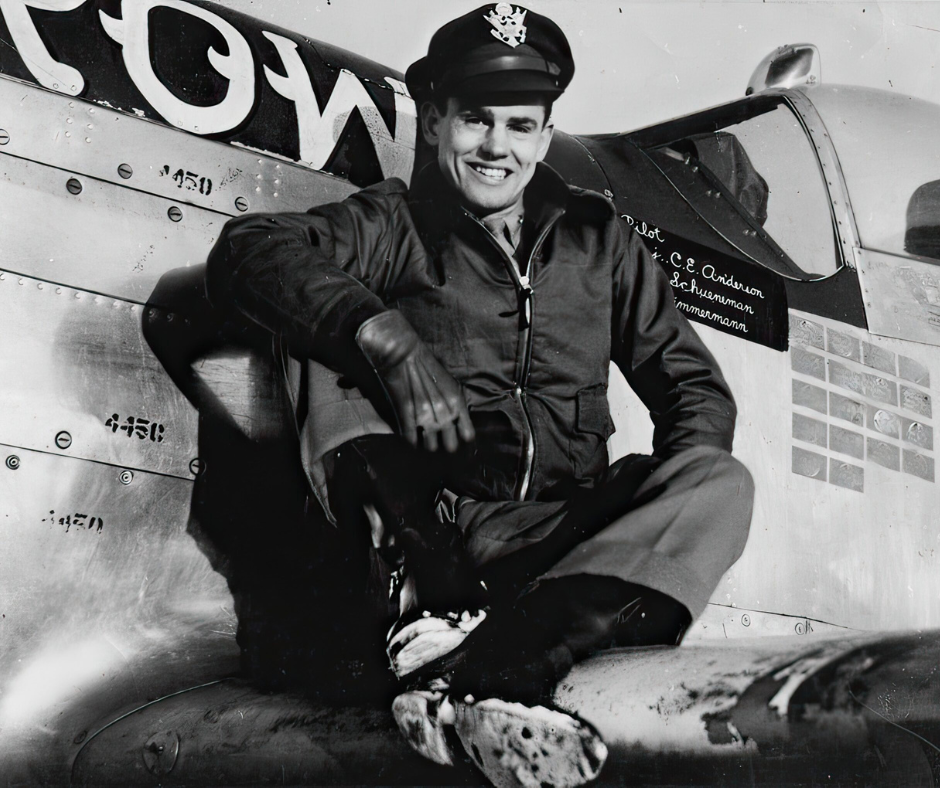
The aircraft that would become the iconic “Old Crow” was one of the early P‑51Bs, serial number 43‑24823, later adorned with the distinctive red‑and‑yellow checker nose and smoothly transparent “Malcolm Hood” canopy for enhanced visibility.
It was in this Mustang that Anderson fought through D‑Day and scored the majority of his 16 victories during his first combat tour—becoming a full-fledged triple ace.
The Mustang didn’t just support Bud; it became an extension of him—a sleek, lethal partner forged at the cutting edge of aerial combat.
Combat Brilliance in Blue Skies
By spring of 1944, Anderson was already making history. On a mission over Berlin in May, “Old Crow” delivered its first Fw 190 kill over Soltau, Germany. Day after day, the P‑51 and its pilot flew long-range bomber escort missions, using their unmatched speed and range to weave through European skies. Anderson’s mastery of formation flying, gunnery, and tactical insight meant he not only survived but thrived—even after 116 combat sorties in that Mustang, always flying aggressive missions without a single bailout or aborted sortie .
That mustard-colored, semi-gleaming P‑51 with invasion stripes became iconic. With kills including Fw 190s and Me 109s, Anderson earned his reputation—and with it, the Mustang’s fame grew. His last confirmed victories in the P‑51 B came in December 1944—downing two Fw 190s and adding a probable—before ending his first tour. Those missions in “Old Crow” cemented both pilot and plane in the annals of air combat legend.
A Mustang’s Many Lives and Legacy
After Bud’s departure in late July 1944, the original “Old Crow” passed to Lieutenant Bill Overstreet and was renamed “Berlin Express,” later ending up in a training role—the Mustang’s career continued, though on a quieter path. Yet the name “Old Crow” lived on, transferred to airworthy tributes: P‑51Bs and P‑51Ds that would keep the legend alive long after WWII.
One notable restoration began in 2002 when famed automotive engineer and pilot Jack Roush painstakingly rebuilt a crashed P‑51B (serial 43‑12252) recovered from a Florida lake. Rechristened N551E, by 2004 the aircraft was flying again, adorned in faithful early “Old Crow” paint with the Malcolm Hood, and once won Reserve Grand Champion WWII Warbird and a Golden Wrench award at Oshkosh. It later passed to Jim Hagedorn under the Liberty Foundation and continues flying today under N451MG.
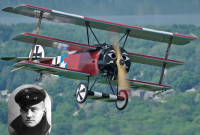
You May Like To Read: The Red Baron: Aviation’s first Superstar.
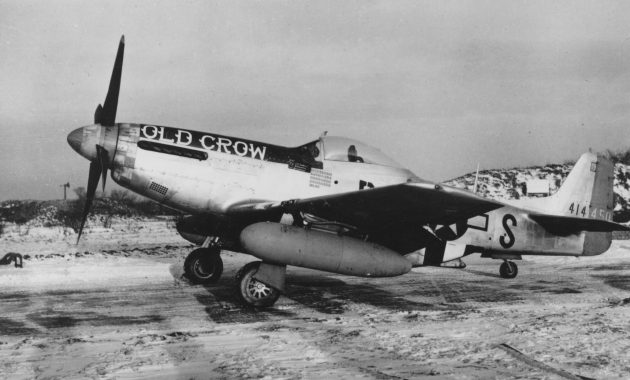
Another “Old Crow,” a later P‑51D‑10 NA (44‑74450), lives on in Europe—painted in natural metal finish with iconic B6‑S markings o honor Col. Anderson, and flies out of Scandinavia and Belgium. Multiple reproductions keep “Old Crow” airborne at airshows across the globe—including appearances at Oshkosh and Biggin Hill, carrying forward Bud Anderson’s legacy.
Enduring Charm: Performance, Patriotism, and Pilots
What continues to enchant audiences about “Old Crow”? It’s the perfect storm of raw P‑51 Mustang performance, Bud Anderson’s gallantry, and a machine restored to near-authentic glory. The Mustang itself was an engineering marvel—long-range, fast (over 400 mph), and lethal in both air-to-air and ground-attack roles . Add iconic markings—a bubble canopy, checkerboard nose, invasion stripes—and the effect is electrifying.
Moreover, Bud Anderson remains a living hero. Even well into the 2000s, he flew formation over Oshkosh with fellow legend Chuck Yeager—55 years after WWII. Anderson’s humility and dedication have inspired Ford and Roush to name a Mustang GT muscle car after him—helping fund aviation scholarships and celebrate his legacy.
“Old Crow” Today: From Runway to Runway, Story to Story
Today, P‑51 Mustang “Old Crow” is more than a flying warbird—it’s a cultural icon. At airshows like Oshkosh and the Columbus Air Show, she amazes crowds with razor-sharp maneuvers, roaring Merlin engine tone, and a tale rooted in heroism. Pilots and restoration crews speak of the fine craftsmanship needed to stay authentic—rebuilding canopies with only period photos as references , sourcing vintage Merlin parts, and ensuring flight safety for modern crowds.
Even social media buzzes when “Old Crow” hits trouble—like a July 2024 flight to Oshkosh when its Merlin engine quit at 10,000 ft. The pilot glided to a safe landing at Milwaukee’s KMKE, with zero damage—proof of the Mustang’s enduring reliability and vitality.
Final Thoughts
The enduring tale of “Old Crow” is woven from threads of engineering excellence, aerial heroism, and heartfelt restoration. Bud Anderson’s Mustang wasn’t just a wartime tool—it was an extension of a pilot’s courage and ingenuity, soaring above danger in defense of freedom. Every airshow pass, every story from vets who remember their buddies, and every meticulous bolt tightened in a restoration hangar, keeps that spirit alive.