militaryandtech.com- When the Focke-Wulf Fw 190 first appeared over the battlefields of Europe it shocked Allied pilots and engineers alike. Designed by Kurt Tank and introduced into Luftwaffe service in 1941, the Fw 190 combined ruggedness, raw power and excellent handling into a compact, fast fighter that quickly became the backbone of Germany’s tactical air forces. Its nickname among German pilots was Würger (Butcher Bird) — a nod to its aggressive performance and the fear it inspired in opponents.
Origins and design philosophy
The Fw 190 emerged from a late-1930s effort to build a fighter that would complement the Bf 109, not compete for the same engines or the same tactical niche. Kurt Tank’s design used a powerful air-cooled radial engine (initially the BMW 139 on prototypes, and later the larger, more successful BMW 801 series on production models).
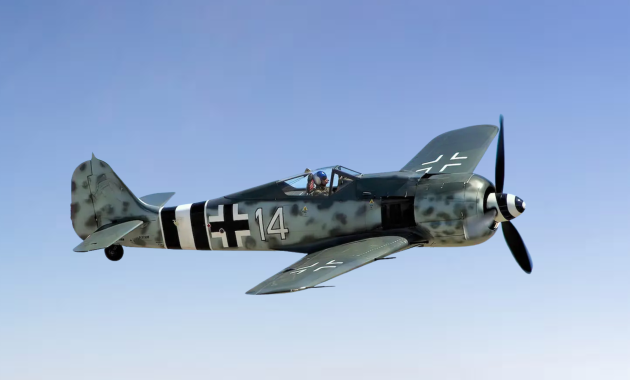
Choosing a radial engine was both tactical and practical: it avoided draining scarce inline engines (Daimler-Benz series) and gave the aircraft a robust, well-protected powerplant that absorbed damage better than liquid-cooled engines. Tank and Focke-Wulf also prioritized survivability, pilot protection and easy maintenance, traits that made the 190 exceptionally serviceable from frontline bases.
A distinctive feature of the Fw 190’s airframe was its compact, muscular look: a short nose, broad fuselage and wide track undercarriage that made ground handling far superior to the Bf 109. The cowling and cooling system around the radial engine were refined (including an oversized spinner and clever fan/cowling arrangements) to reduce drag while maintaining cooling., a vital balance that helped the 190 achieve high low-to-medium altitude performance. The BMW 801 also used an engine management system (the Kommandogerät) to automate mixture, boost and propeller pitch, which simplified engine control for pilots under combat stress.
Prototypes to production
The first prototype flew on 1 June 1939, and production-ready A-series fighters entered service in 1941. Early production machines (A-0 pre-production and A-1/A-2 series) established the airframe’s core strengths: speed, roll rate and a heavy weapons fit compared to contemporary fighters. The Luftwaffe rapidly adapted the 190 to multiple roles — pure day fighter, fighter-bomber (Jabo), ground-attack (F series) and long-range escort variants — exploiting the platform’s structural strength and payload capacity.
Armament and internal layout
One reason the Fw 190 was feared was its concentrated and flexible firepower. Typical early A-series armament included two fuselage machine guns and wing-mounted combinations of 20 mm cannons and machine guns; later versions increased calibre and ammunition capacity to fight heavy USAAF bombers. The wide, sturdy wings allowed for heavy armament, underwing racks for bombs or drop tanks, and even specialist pods and rocket mortars for anti-bomber missions. This adaptability made the Fw 190 an ideal platform for close air support and fighter-bomber operations on the Eastern Front and in the West.
Performance: low-level dominance and high-altitude limits
One of the defining characteristics of the BMW-powered Fw 190 A-series was its outstanding low-to-medium altitude performance. At low levels the 190 was fast, stable, and had an excellent roll rate — qualities that made it a deadly opponent in dogfights and in attacks against Allied tactical aircraft. However, the A-series lost performance at higher altitudes (roughly above 6,000 m / 20,000 ft), where the single-stage supercharged BMW 801 could not match the altitude performance of some inline-engine foes and high-altitude escort fighters.
This altitude limitation encouraged development of specialized high-altitude variants and ultimately led to the Fw 190 D (the “Dora”) equipped with a liquid-cooled Jumo 213 inline engine to restore high-altitude capability.
Variant evolution — lots of letters, lots of roles
The Fw 190 family is famously diverse. Key production series included:
- Fw 190 A (fighter): The main production series with BMW 801 radial engines. Many sub-types (A-1 through A-9) introduced incremental improvements in armament, engine versions and equipment. The A-8, for example, became one of the most produced and useful sub-types and was often used as a fighter-bomber.
- Fw 190 F / G (ground-attack / long-range fighter-bomber): Built and modified for close air support and anti-shipping/strike roles, with structural reinforcements and bomb racks. These variants capitalized on the 190’s ruggedness.
- Fw 190 D (Dora): Introduced late in the war (1944) and fitted with the Junkers Jumo 213 inline engine. The D-series regained high-altitude performance and had a longer nose, improved speed and better high-altitude breathing compared with the A-series. Museums and restoration projects (and surviving examples like the D-9) often highlight the Dora as an interim step toward the even more advanced Ta 152.
There were also specialized prototypes, night-fighter conversions, training and reconnaissance versions — underscoring how central the 190 was to Luftwaffe tactical operations.
Combat record and operational history
The Fw 190 first shocked the Allies in 1942 when an A-3 mistakenly landed intact at RAF Pembrey (Wales) after its pilot navigationally erred; the captured machine was quickly evaluated by the Royal Aircraft Establishment, giving British engineers first-hand insight into the new fighter’s qualities.
From 1942 onward the Fw 190 proved formidable over the Channel, in the Battle of the Atlantic’s coastal battles, on the Eastern Front and in defence against Allied bombing raids. It was particularly effective in the low-to-medium altitude band where most tactical air combat and ground attack missions took place.
As Allied heavy bomber formations increased in size and defended themselves with longer escorts, the Luftwaffe adapted the 190 into heavy ground-attack and anti-bomber roles. Heavier wing-mounted cannons, rocket launchers and special armour packages appeared on later models — an attempt to put enough firepower in a single pass to bring down four-engine bombers. The transition was costly: heavier armament and extra equipment degraded manoeuvrability and increased maintenance strain, but they were necessary responses to Allied air strategy.
Production and numbers
Production of the Fw 190 spanned roughly 1941–1945. Estimates put total production of all types at around 19,000–20,000 aircraft, making it one of Germany’s most numerous wartime fighters. The exact figure varies by source; contemporary ministry and factory records plus postwar accounting generally agree on a number near 19,000. The sheer volume of 190s produced demonstrates how quickly the type became central to Luftwaffe operations.
Surviving examples and legacy
A number of Fw 190s survive in museums today (for example at the RAF Museum and the Smithsonian’s National Air and Space Museum has D-series examples and documentation). Restorations and preserved airframes give historians and enthusiasts a chance to study the machine’s robust engineering up close. The design’s influence extends beyond wartime statistics: lessons from the 190’s blend of rugged radial-engine practicality, modular armament, and good pilot ergonomics informed later aircraft thinking about survivability and multi-role flexibility.