History often remembers turning points in war as moments that happened suddenly: the tide turned, the enemy faltered, and the heroes charged in. But sometimes, a turning point almost happened—nearly but not quite shifting the course of history. One of the most fascinating “what-ifs” of World War II is the story of the Messerschmitt Me 262, the world’s first operational jet-powered fighter aircraft.
Fast, deadly, and technologically decades ahead of its time, the Me 262 was a masterpiece of engineering trapped in a war that was already slipping away from its creators. Had it been deployed earlier or in greater numbers, the entire air war over Europe might have looked very different. Instead, the Me 262 became a symbol of innovation shackled by politics, pride, and poor timing.
The Birth of a Jet Age
When we think of fighter planes in World War II, the mental image is usually one of sleek piston-engine aircraft: Spitfires, Mustangs, Thunderbolts. But as early as the late 1930s, German engineers were thinking beyond propellers. Visionaries like Hans von Ohain—working under Ernst Heinkel—were already experimenting with jet propulsion.
Meanwhile, at Messerschmitt AG, work began in 1938 on what would become the Me 262, a sleek, shark-like aircraft powered by twin Junkers Jumo 004 turbojet engines. The goal was revolutionary: create a fighter that could fly faster than any Allied aircraft, intercept high-altitude bombers, and regain air superiority for the Luftwaffe.
But from the beginning, the program faced setbacks.
Jet engines were a new and fragile technology. The Jumo 004s had a lifespan of only 10–25 flight hours and were notoriously prone to failure. High-speed aerodynamics were not yet fully understood, and test flights revealed stability issues, engine flameouts, and landing gear failures. These were not insurmountable problems, but they took time—time Germany didn’t have.
Hitler’s Interference: A Deadly Detour
Arguably, the biggest single obstacle to the Me 262’s success wasn’t technical—it was political.
In 1943, as the jet neared operational readiness, Adolf Hitler personally intervened in its development. Rather than supporting the Me 262 as a pure interceptor, Hitler insisted that it be configured as a fighter-bomber, a “Blitzbomber”, capable of carrying bombs to attack ground targets. He envisioned it as a strategic weapon that could strike quickly and decisively—an offensive weapon, not just a defensive one.
This decision delayed the aircraft’s deployment by months. Engineers were forced to modify the airframe to carry bombs, which compromised performance. Meanwhile, Allied bombers continued to pound German cities and industrial centers. By the time Hitler relented and allowed the Me 262 to be used as a fighter, it was too late.
Taking to the Skies
The Me 262 finally entered combat in mid-1944, with specialized jet units like Jagdgeschwader 7 (JG 7) being formed to fly it. The aircraft was astonishing.
With a top speed of over 870 km/h (540 mph)—a full 200 km/h faster than any Allied fighter—the Me 262 could outrun almost everything in the sky. It was armed with four 30mm MK 108 cannons, which could tear through bombers in a few bursts. Later variants were equipped with R4M air-to-air rockets, capable of taking out bombers from a distance.
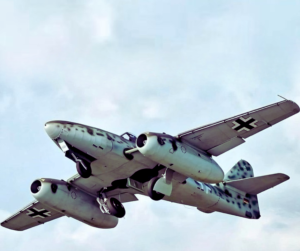
When flown properly, the Me 262 was nearly untouchable. It would swoop in from above or behind, unleash devastating firepower, and disappear before Allied fighters could react. The Allied air forces called it the “Stormbird” or “Schwalbe” (Swallow) and feared its appearance on the battlefield.
But there was a catch. Several, in fact.
The Flaws Beneath the Speed
For all its technical brilliance, the Me 262 had serious limitations.
First, it was fragile on takeoff and landing. Jet engines took much longer to spool up than piston engines, making the aircraft vulnerable during its most exposed moments. Allied pilots quickly learned to circle above Me 262 bases and shoot the jets down as they tried to land.
Second, the Me 262 required extensive maintenance and highly trained ground crews. Its engines, built with scarce war materials, were prone to overheating and failure. Poor fuel quality and a lack of spare parts didn’t help.
Third—and most crucially—the Luftwaffe could never deploy enough of them. By the end of the war, only around 1,400 Me 262s were built, and of those, fewer than 300 ever saw combat. Germany’s decimated industrial base and Allied bombing campaigns made large-scale production nearly impossible.
In the end, the Me 262 was a case of too little, too late.
Jet vs Propeller: The Final Dogfights
Even with its small numbers, the Me 262 left a major impression. When flown by experienced aces like Adolf Galland or Walter Nowotny, it was a deadly adversary.
Allied forces scrambled to develop tactics to counter it. P-51 Mustang pilots were advised not to chase the Me 262 during high-speed dives—instead, they were told to attack during takeoff and landing, or to bait the jets into turning fights, where their sluggish response at lower speeds could be exploited.
Despite being an interceptor at heart, the Me 262 also served in ground-attack roles. These missions, however, exposed the aircraft to flak and fighters, and losses were high. The Luftwaffe was simply outgunned and outnumbered at this point in the war, and no miracle weapon could change that.
A Legacy That Shaped the Future
Though it failed to turn the tide of the war, the Messerschmitt Me 262 succeeded in something arguably more important: it ushered in the jet age.
Every major postwar air force took notice. The Americans captured several Me 262s and brought them home for testing. The lessons learned from the Me 262 directly influenced the design of early jet fighters like the F-86 Sabre and the MiG-15—aircraft that would go on to define the skies over Korea and beyond.
The Me 262’s legacy can be seen in its aerodynamic design, its swept wings (though not truly swept back like later jets), and its concept of high-speed interception. It was the first aircraft to make the rest of the aviation world realize: the propeller era was over.
The Human Side of Innovation
Behind every Me 262 was a team of scientists, pilots, mechanics, and visionaries who pushed the limits of what was possible. One of the more tragic aspects of the story is how many of these individuals were caught in the web of Nazi ideology, forced to serve a regime they didn’t all believe in.
There’s also the ethical complexity of the Me 262. It was a tool of war, built by a nation engaged in some of history’s most horrific crimes. Yet the aircraft itself, and the people who created it, were also symbols of human ingenuity, scientific exploration, and the eternal drive to fly faster, higher, better.
After the war, many of the engineers behind the Me 262 went on to work for Allied powers. Some joined the American aerospace industry; others helped build the Soviet jet fleet. The technology survived, even if the ideology that birthed it did not.
The Me 262 Today
A few Me 262s survive in museums around the world. Some are originals; others are modern reproductions built to flying standards using original blueprints and modern materials.
Seeing one in person is a breathtaking experience. Its clean lines, aggressive posture, and futuristic look seem out of place among its WWII peers. It looks more like something from the 1960s than the 1940s. It’s easy to imagine what might have happened if hundreds—rather than dozens—had taken to the skies.
Conclusion: The Jet That Arrived Too Late
The Messerschmitt Me 262 is one of those rare machines that seems to leap forward in time, defying the era in which it was built. It was a technological marvel that hinted at the future of air combat—a future that arrived too slowly to save its creators.
More than just a piece of hardware, the Me 262 represents the collision of innovation and desperation, of science and ideology, of genius and failure. It’s a reminder that winning wars isn’t just about having the best weapons—it’s about having them at the right time, in the right numbers, and with the right vision.
The Me 262 had two out of three.