militaryandtech.com – The Saab 35 Draken, meaning “The Kite” or “The Dragon” in Swedish, was a groundbreaking supersonic fighter-interceptor developed by SAAB between 1955 and 1974, and became a symbol of Swedish innovation during the Cold War.
Originally conceived in 1948 to replace the Saab 29 Tunnan and complement the all-weather Saab 32 Lansen, the Draken introduced a revolutionary double-delta wing design—so radical at the time that SAAB built a sub-scale test aircraft, the Saab 210, just to prove its aerodynamic viability.
When it entered frontline Swedish Air Force service on March 8, 1960, the Draken marked a series of aviation firsts: it was the first fully supersonic aircraft designed and built in Western Europe to enter service, the first to exceed Mach 2 in level flight, and the first known jet capable of performing the dramatic Cobra maneuver.
Though designed primarily as an interceptor, it proved to be an agile and capable dogfighter, undergoing numerous upgrades over its career, culminating in the J 35J variant. By the mid-1980s, it began to be phased out in favor of the more advanced JA 37 Viggen and, later, the JAS 39 Gripen.
Saab 35 Draken: Sweden’s Supersonic Leap into the Jet Age
In the world of Cold War aviation, few aircraft combine bold design, innovation, and national pride quite like the Saab 35 Draken. With its unmistakable double-delta wing and sleek, arrow-like profile, the Draken wasn’t just a symbol of Swedish engineering excellence. It was a supersonic statement. Developed during a time of rising global tensions, this jet fighter didn’t just meet the challenges of the jet age, it soared past them with confidence.
Specifications
The Saab 35 Draken was a single-seat, high-speed fighter-interceptor developed by SAAB (Svenska Aeroplan AB). Designed with cutting-edge Cold War performance in mind, the Draken measured 15.35 meters in length, had a wingspan of 9.42 meters, and stood 3.89 meters tall. Weighing in at 7,865 kilograms empty and capable of a maximum takeoff weight of 12,000 kilograms, it was powered by a single Volvo RM6C turbojet engine, a license-built Rolls-Royce Avon, producing up to 17,620 pounds of thrust with afterburner.
This gave the aircraft an impressive top speed of Mach 2.0, or about 2,120 km/h, with an operational range of 1,200 kilometers and a ceiling reaching 20,000 meters. Armed with two 30 mm cannons, AIM-9 Sidewinder air-to-air missiles, and the capability to carry rockets and bombs, the Draken was a formidable interceptor built to defend Sweden’s skies with both speed and firepower.
| Saab 35 Draken – General Specifications (J 35F Variant) | |
|---|---|
| Role | Fighter-Interceptor |
| Manufacturer | SAAB (Svenska Aeroplan AB) |
| First Flight | 25 October 1955 |
| Introduced | 8 March 1960 |
| Crew | 1 (single-seat) |
| Length | 15.35 m (50 ft 4 in) |
| Wingspan | 9.42 m (30 ft 11 in) |
| Height | 3.89 m (12 ft 9 in) |
| Empty Weight | 7,865 kg (17,344 lb) |
| Max Takeoff Weight | 12,000 kg (26,455 lb) |
| Engine | 1 × Volvo RM6C turbojet (Rolls-Royce Avon) |
| Thrust (with afterburner) | 17,620 lbf (78.4 kN) |
| Maximum Speed | Mach 2.0 (2,120 km/h or 1,320 mph) |
| Range | 1,200 km (750 mi) |
| Service Ceiling | 20,000 m (65,600 ft) |
| Armament | 2 × 30 mm cannons, AIM-9 Sidewinders, rockets, bombs |
You May Like To Read: A-10 Warthog Specifications, Variants, and Legacy.
Designed for Neutrality, Built for Survival
Sweden has always taken a unique approach to national defense. As a neutral country positioned between the NATO alliance and the Soviet bloc, it could not rely on outside military support. That meant Sweden had to design, build, and operate its own advanced aircraft, fully independent of foreign suppliers. It was a tall order, but for SAAB, the country’s primary aircraft manufacturer, it was a challenge worth taking.
In the late 1940s, the Swedish Air Force faced an urgent need. Its existing fighter, the stubby but capable Saab 29 Tunnan, had served well in the early jet age. However, it was no match for the emerging threat of supersonic nuclear bombers. Sweden needed a new interceptor, one that could fly faster, climb higher, and respond quickly to any incursion into Swedish airspace. That was the spark that led to the development of what would become the first supersonic fighter produced in Western Europe.
Innovation in Aerodynamics
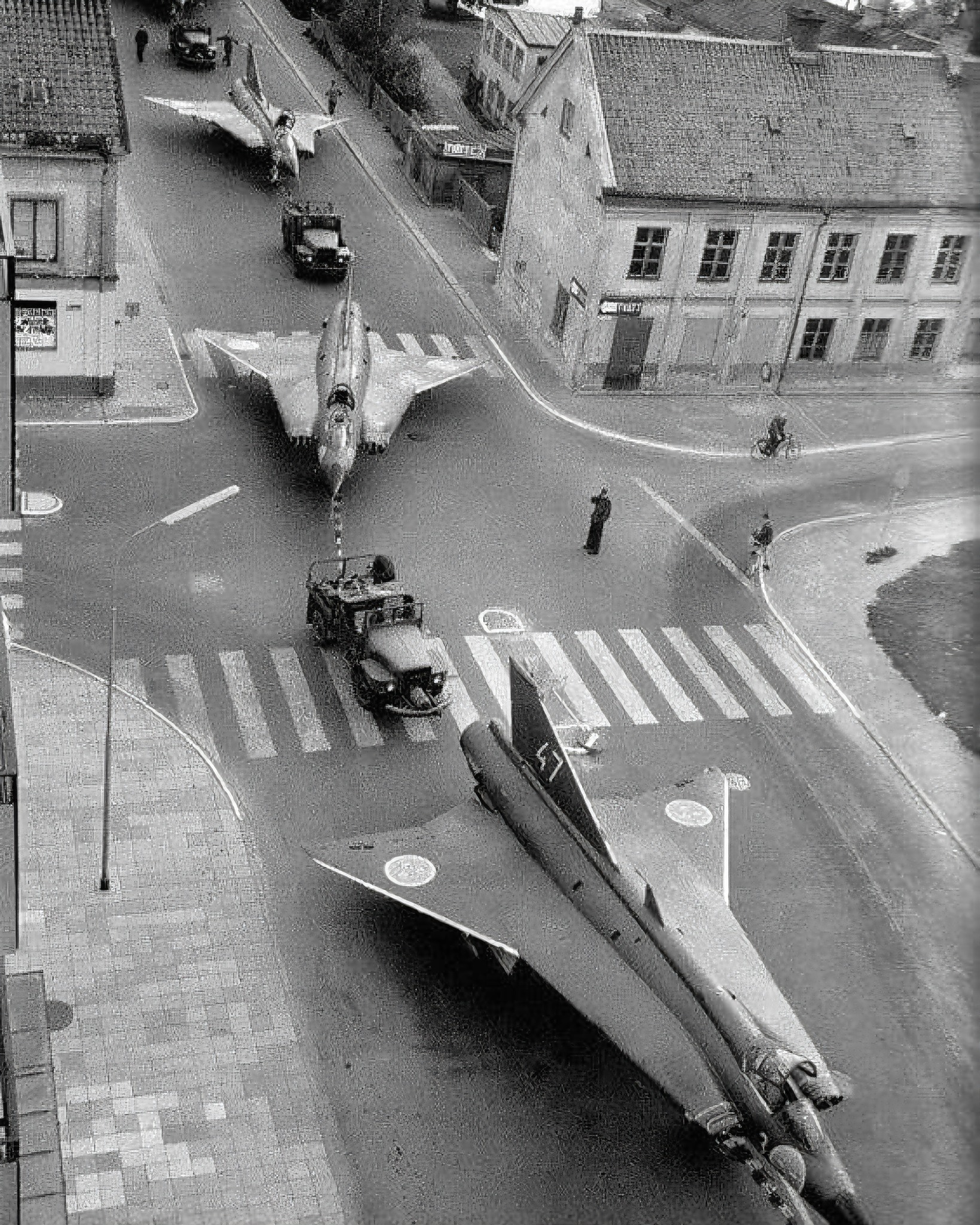
Design work on the Saab 35 Draken began in 1948, a time when engineers around the world were still trying to understand supersonic flight. Swedish designers faced a critical challenge: they needed a fast and powerful jet that could also operate from Sweden’s unconventional wartime airbases, which included short runways and stretches of public highways.
The result was a bold leap in aerodynamic design. Instead of using a conventional swept-wing layout, SAAB introduced a revolutionary double-delta wing. This configuration featured a broader inner wing for better control at lower speeds and a sharper outer wing optimized for supersonic performance. The unusual shape gave the Draken its iconic silhouette, but it was far more than just cosmetic. It was a solution that allowed the aircraft to remain agile at low speeds while maintaining high-speed stability.
To test this groundbreaking idea, SAAB built a scaled-down test aircraft, the Saab 210, affectionately known as “Lill-Draken” or “Little Dragon.” This small, experimental jet first flew in 1952 and played a vital role in validating the design before full-scale development continued.
Taking to the Skies
The first full-size Saab 35 Draken prototype made its maiden flight in 1955. The aircraft immediately showed promise. It was sleek, fast, and clearly ahead of its time. On March 8, 1960, the Draken officially entered service with the Swedish Air Force. Sweden, a neutral country, had just deployed the most advanced indigenous fighter in Europe.
The Draken was powered by the RM6C turbojet engine, a Swedish-built version of the British Rolls-Royce Avon. With its afterburner engaged, the aircraft could fly at speeds exceeding Mach 2. That put it in an elite class of fighters at the time, rivaling American and Soviet jets in raw speed and performance. On January 14, 1960, a Draken became one of the first European fighters to exceed Mach 2 in level flight.
But speed was only part of the story. The Draken’s aerodynamics allowed it to execute high-angle maneuvers and tight turns, making it extremely capable in dogfights. In fact, it was the first known aircraft capable of performing the Cobra maneuver, a sudden pitch-up move later made famous by Russian fighters. It was a clear sign of just how ahead of its time the design truly was.
More Than an Interceptor
Although the Draken was built as an interceptor to shoot down enemy bombers, it quickly proved itself to be much more versatile. Pilots discovered that its double-delta wing gave it excellent agility in close-range combat, even at lower speeds. This allowed the aircraft to be used in secondary roles like ground attack and air superiority.
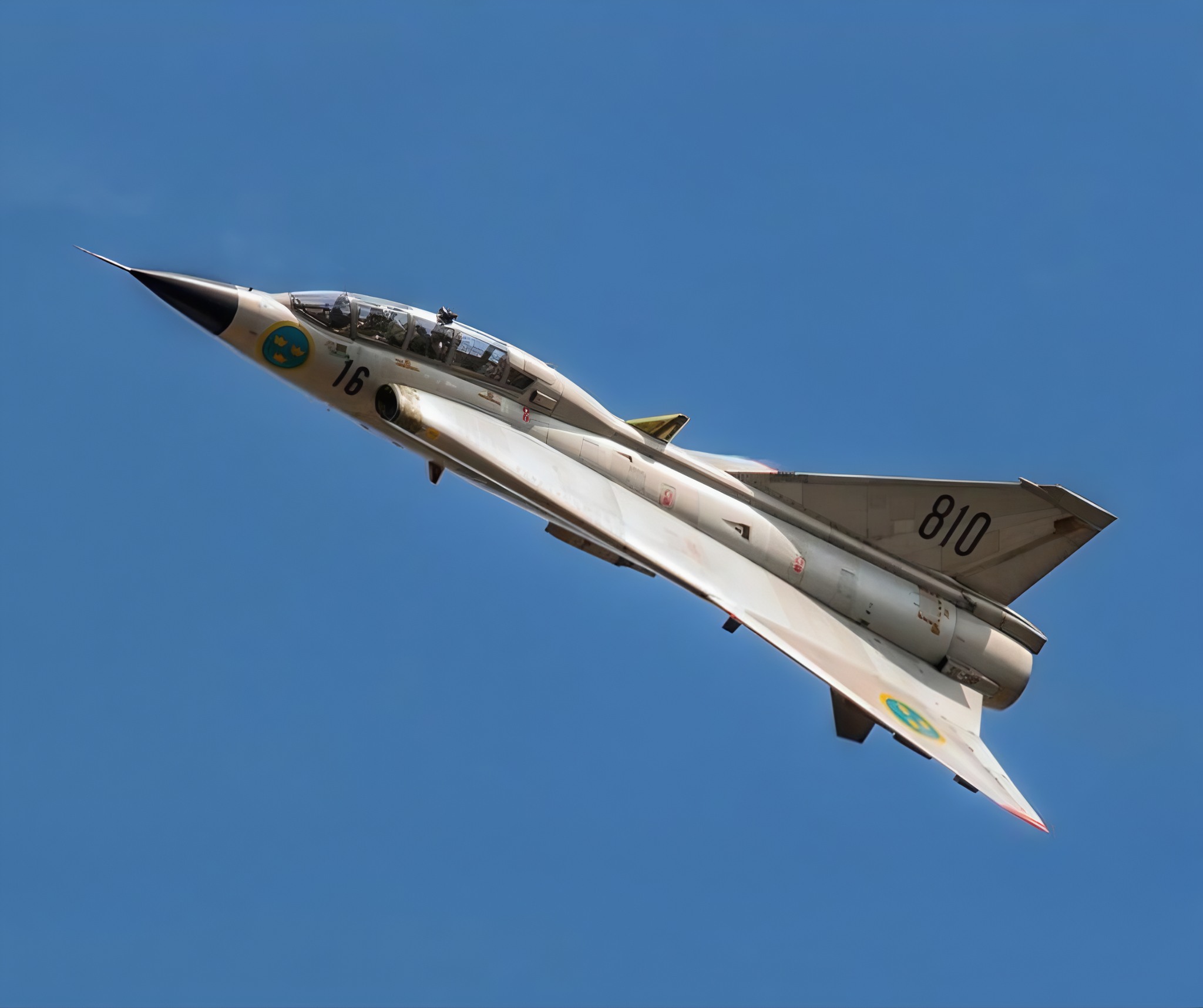
Over the years, SAAB developed several upgraded versions of the Draken. These included improved radars, stronger engines, and upgraded weapons systems. The jet was originally armed with 30 mm cannons and later adapted to carry Sidewinder air-to-air missiles, giving it teeth against both fast-moving bombers and fighters.
Here are some of the key versions of the Draken:
-
The J 35A was the original production model with basic avionics.
-
The J 35B added more advanced radar and better all-weather capabilities.
-
The J 35D featured a more powerful engine and new electronics.
-
The J 35F became the backbone of Sweden’s air defense during the Cold War, with improved fire-control systems and infrared missiles.
-
The final variant, the J 35J, was a modernized version with updated avionics and countermeasures, allowing the Draken to remain in service into the 1990s.
Each upgrade reflected Sweden’s commitment to maintaining a high-performance fighter fleet without relying on foreign aircraft.
Global Reach (Operators)
The Draken was not just a Swedish success story. Other nations took notice of its performance and capabilities. Austria, Denmark, and Finland all purchased Drakens, each customizing them to meet their own defense needs.
Denmark used its Drakens not only for interception but also for ground attack missions, making it one of the most versatile operators of the type. Finland, with its long and often icy runways, valued the Draken for its reliability and robust design. Austria kept its Drakens in service until 2005, making it the last country to retire the type from active duty.
Interestingly, after their military careers ended in Europe, several Danish Drakens found a second life in the United States. There, they were used as training aircraft for test pilots and in aggressor roles simulating enemy aircraft, demonstrating the aircraft’s longevity and adaptability.
No Battles, But A Strategic Role
Despite its long and distinguished career, the Saab 35 Draken never saw combat. Yet that doesn’t diminish its importance. The very presence of the Draken in Sweden’s air force served as a powerful deterrent during the Cold War. It helped secure Swedish airspace and gave the country a credible defense posture without needing to align with any military bloc.
Its value lay in readiness, not destruction. The Draken was fast, reliable, and always prepared to respond to a threat. In the chessboard of Cold War politics, that mattered just as much as firepower.
Farewell and Legacy
By the 1980s and 1990s, the pace of aviation technology had accelerated. The arrival of more advanced fighters like the JA 37 Viggen and eventually the Saab JAS 39 Gripen meant the Draken’s time was coming to an end. Sweden gradually retired its fleet, with the last operational Drakens leaving service in 1999.
But retirement did not mean obscurity. The Saab 35 Draken left a lasting legacy. It had proven that a small, neutral nation could produce a world-class fighter jet entirely on its own. It had pushed the boundaries of aerodynamics, shown engineers what was possible, and helped shape the next generation of combat aircraft.
Today, you can find preserved Drakens in museums around the world. Some are even still airworthy and fly at airshows, turning heads just as they did in their prime. To see a Draken in flight is to witness a moment in history where daring design and national determination came together in one unforgettable aircraft.
A Swedish Masterpiece
The Saab 35 Draken stands as one of the most successful and visually striking fighters of its era. From its radical double-delta wing to its Mach 2 performance, the Draken was a perfect embodiment of Swedish innovation. It helped protect a nation’s skies for nearly four decades, trained generations of pilots, and showed the world that great engineering doesn’t only come from superpowers.
More than just a jet, the Draken was a symbol. A symbol of independence, creativity, and the bold spirit of a country that dared to take flight on its own terms.