The Fairchild Republic A-10 Thunderbolt II, more commonly known as the A-10 Warthog—or simply “Hog”—is a rugged, single-seat, twin-turbofan, straight-wing subsonic attack aircraft developed for the United States Air Force and in service since 1977.
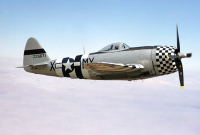
Named after the WWII-era Republic P-47 Thunderbolt, the A-10 was purpose-built for close air support (CAS), making it the only aircraft ever designed solely for this mission to serve with the USAF. It specializes in attacking enemy tanks, armored vehicles, and ground forces, and it also plays a critical secondary role as an airborne forward air controller (FAC), coordinating attacks on ground targets—aircraft in this role are designated OA-10.

Developed to surpass the performance and firepower of the Douglas A-1 Skyraider, the A-10 was uniquely engineered around its powerful 30 mm GAU-8 Avenger rotary cannon. Its airframe prioritizes survivability, incorporating 1,200 pounds of titanium armor to shield the cockpit and critical systems, allowing it to sustain heavy damage and remain airborne.
Designed with simplicity and battlefield practicality in mind, the A-10 can take off and land on short or unprepared runways near front-line operations and can be maintained with minimal support infrastructure, making it one of the most dependable and enduring aircraft in the Air Force arsenal.
Specifications
The A-10 was designed around survivability, firepower, and simplicity. With a length of 53 ft 4 in (16.26 m), a wingspan of 57 ft 6 in (17.53 m), and a height of 14 ft 8 in (4.47 m), the aircraft offers a stable platform for low-speed, low-altitude attacks. It has a wing area of 506 ft² (47.0 m²) and weighs 24,959 lb (11,321 kg) when empty, with a maximum takeoff weight of 51,000 lb (23,000 kg).
Powered by two General Electric TF34-GE-100A turbofan engines, each delivering 9,065 lbf (40.34 kN) of thrust, the A-10 reaches speeds of up to 420 knots (482 mph, 776 km/h) and cruises comfortably around 300 knots (345 mph, 555 km/h). Its combat range is 800 nautical miles (1,500 km), and it can ferry up to 2,240 nautical miles (4,150 km) with drop tanks.
Notably, the A-10 excels in endurance, able to climb at 6,000 ft/min (30.5 m/s) and operate at altitudes up to 45,000 ft (13,700 m). Central to its lethality is the GAU-8/A Avenger, a 30 mm rotary cannon with 1,174 rounds, complemented by 11 hardpoints that support a weapons load of up to 16,000 lb (7,260 kg) including AGM-65 Mavericks, various bombs, rockets, and AIM-9 Sidewinders. Avionics include the AN/AAS-35(V) Pave Penny laser tracker, AN/ALR-69 radar warning receiver, and advanced targeting pods like LITENING or Sniper XR in its modernized A-10C configuration.
The cockpit is night-vision compatible and protected by 1,200 lb (540 kg) of titanium armor, often referred to as the “bathtub,” designed to shield the pilot and key systems. With redundant dual hydraulic and manual flight controls, and the ability to operate from short, rough airstrips, the A-10 remains a uniquely rugged and effective ground-attack aircraft.
Fairchild Republic A-10 Thunderbolt II – General Specifications
| General Information | |
|---|---|
| Role | Close Air Support (CAS) Aircraft |
| Manufacturer | Fairchild Republic |
| First Flight | May 10, 1972 |
| Introduced | March 1977 |
| Crew | 1 (pilot) |
| Dimensions | |
| Length | 53 ft 4 in (16.26 m) |
| Wingspan | 57 ft 6 in (17.53 m) |
| Height | 14 ft 8 in (4.47 m) |
| Wing Area | 506 ft² (47.0 m²) |
| Weight | |
| Empty Weight | 24,959 lb (11,321 kg) |
| Loaded Weight | 30,384 lb (13,787 kg) |
| Maximum Takeoff Weight | 51,000 lb (23,000 kg) |
| Powerplant | |
| Engines | 2 × General Electric TF34-GE-100A turbofans |
| Thrust (each) | 9,065 lbf (40.34 kN) |
| Performance | |
| Maximum Speed | 420 knots (482 mph, 776 km/h) at sea level |
| Cruise Speed | ~300 knots (345 mph, 555 km/h) |
| Range (combat) | 800 nmi (920 mi, 1,500 km) |
| Ferry Range | 2,240 nmi (2,578 mi, 4,150 km) with drop tanks |
| Service Ceiling | 45,000 ft (13,700 m) |
| Rate of Climb | 6,000 ft/min (30.5 m/s) |
| Armament | |
| Gun | 1 × 30 mm GAU-8/A Avenger rotary cannon (1,174 rounds) |
| Hardpoints | 11 (8 under-wing, 3 under-fuselage) |
| Maximum Ordnance Load | 16,000 lb (7,260 kg) |
| Supported Weapons | AGM-65 Maverick, bombs (guided/unguided), rockets, AIM-9 Sidewinders, ECM pods |
| Avionics & Features | |
| Laser Tracker | AN/AAS-35(V) Pave Penny |
| Radar Warning Receiver | AN/ALR-69 |
| Cockpit | Night vision-compatible, upgraded to glass cockpit in A-10C |
| Targeting Pods | LITENING or Sniper XR (A-10C) |
| Armor Protection | 1,200 lb (540 kg) titanium “bathtub” for pilot and systems |
| Flight Control Redundancy | Dual hydraulic + manual backup |
| STOL Capability | Yes – can operate from short/unprepared runways |
You May Like To Read: Saab JAS 39 Gripen: Sweden’s Silent Power in the Sky.
A-10 Warthog Variants:
The Warthog, has undergone a relatively small number of official variants since its inception, but each has played a critical role in adapting the aircraft to evolving combat demands. The original production model, designated simply as the A-10A, was introduced in 1977 and focused exclusively on the Close Air Support (CAS) mission. It featured a basic avionics suite centered around manual targeting and unguided weapons delivery, relying on the pilot’s visibility and skill.
The A-10A was equipped with the Pave Penny laser spot tracker, but it could not designate laser targets itself. Over 700 units of this variant were built, and it served as the backbone of the USAF’s CAS capability throughout the Cold War and into the 1990s.
A second, lesser-known variant is the OA-10A, which was identical to the A-10A in terms of airframe and performance, but designated for the Forward Air Control (FAC) role. These aircraft were used to direct airstrikes and coordinate with ground forces during combat operations. While capable of carrying weapons, OA-10As typically flew with lighter loads to maintain agility and visibility.
The OA-10A retained the same systems as the A-10A and could switch between CAS and FAC missions depending on operational needs. Over time, these aircraft were folded back into the A-10 fleet under the same designation, especially as upgrades rendered the distinction less meaningful.
The most significant upgrade in the aircraft’s lineage came with the A-10C, introduced beginning in the mid-2000s as part of the Precision Engagement (PE) Upgrade Program. This modernized variant added digital avionics, including a glass cockpit, hands-on-throttle-and-stick (HOTAS) controls, digital stores management, and the ability to employ precision-guided munitions such as JDAMs and GBU-39 Small Diameter Bombs.
A-10Cs are also equipped with LITENING or Sniper XR targeting pods, dramatically improving the aircraft’s effectiveness in both day and night operations. While no entirely new airframes were built for the A-10C, around 350 existing A-10A units were converted, giving the Warthog a new lease on life in 21st-century warfare. There have been no other operational variants officially adopted, though experimental testbed aircraft such as the YA-10B, a two-seat prototype, were evaluated but never entered production.
Legacy:
The legacy of the A-10 Thunderbolt II, or “Warthog,” is one of unmatched dedication to the Close Air Support (CAS) mission and the troops it protects on the ground. From the Cold War through modern asymmetric warfare, the A-10 has earned legendary status among both aircrews and infantry for its ability to fly low, absorb punishment, and deliver devastating firepower exactly where it’s needed.
Its 30 mm GAU-8/A Avenger rotary cannon—capable of shredding tanks and fortified positions—combined with heavy armor protection and redundant flight systems, made it a flying tank in its own right. Its ability to loiter over the battlefield, take hits, and come back for more gave ground troops a level of reassurance few other aircraft could offer. It became not just a weapon, but a symbol of aerial protection and battlefield dominance.

Throughout its operational life, the A-10 proved its worth in numerous conflicts, including Operation Desert Storm, Operation Allied Force in Kosovo, Operation Enduring Freedom in Afghanistan, and Operation Iraqi Freedom. In each of these theaters, it delivered precise, reliable support against enemy armor, insurgents, and fortified targets. Its effectiveness against tanks in the Gulf War and its ability to operate from austere airstrips in Afghanistan reaffirmed the aircraft’s value in real-world combat.
Despite its relatively slow speed and subsonic design, the Warthog consistently outperformed expectations and remained indispensable, even as newer multirole fighters entered service. Its design—once seen as simplistic—proved to be its greatest strength in an era where maintainability and survivability often meant mission success.
The Warthog’s enduring presence in the U.S. Air Force inventory for over four decades is a testament to its design philosophy: simplicity, survivability, and singular focus on supporting troops. While the Air Force has repeatedly proposed retiring the aircraft in favor of more modern platforms like the F-35, strong support from Congress, military leaders, and soldiers on the ground has kept the A-10 flying well into the 2020s.