militaryandtech.com – In the world of fighter jets where billiondollar budgets, stealth coatings, and hypersonic speeds often dominate the conversation—the Saab JAS 39 Gripen stands apart. Not because it’s the biggest, the fastest, or the most expensive.
In fact, it’s none of those things. What it is, though, is something far more rare: a smart, agile, and cost-effective combat jet that was built not to dominate the world, but to defend one small nation with fierce independence. That nation is Sweden, and the Gripen (“griffin,” named after Saab’s mythical logo) is its pride.
A Fighter Born of Necessity
To understand the Gripen, you first have to understand Sweden’s defense philosophy. Throughout the Cold War and beyond, Sweden remained militarily non-aligned—neither NATO nor Warsaw Pact. Sandwiched between superpowers, it needed to be able to defend itself. That meant building a military force that was agile, technologically advanced, and entirely self-reliant.
Sweden’s defense doctrine emphasized neutrality, territorial defense, and the ability to disperse and operate independently—even if airfields and infrastructure were taken out. The Gripen was designed around these needs.
By the late 1970s, the Swedish Air Force faced a looming problem. Its fleet of Saab Viggens and Drakens—excellent aircraft in their day—was becoming outdated. Rather than buying jets from the U.S. or Europe, Sweden made the bold decision to build its own new multirole fighter from scratch.
Enter Project JAS: Jakt (fighter), Attack, Spaning (reconnaissance)—a true multirole aircraft designed to handle everything.
Designing the Gripen: Flexibility Over Flash
Work on the JAS 39 Gripen began in the early 1980s, and from day one, its design principles focused on versatility, ease of maintenance, and low operating cost. It wouldn’t just be a fighter—it would be a bomber, a reconnaissance platform, and an interceptor all rolled into one.
The first Gripen flew in 1988, and after resolving early flight control issues, it entered operational service in 1996 with the Swedish Air Force.
From the outside, the Gripen is distinctive but not flashy. It has a delta wing and canard configuration, a design that gives it excellent maneuverability and short takeoff/landing capabilities. Its Fly-By-Wire system—one of the first of its kind in Europe—makes it highly agile in a dogfight.
But its real superpower? It can take off from a highway.
Seriously. The Gripen was designed to be dispersed across Sweden’s network of roads, taking off and landing on 800-meter stretches of straight highway if air bases were destroyed in war. It can be refueled and rearmed in 10 minutes by a team of just five mechanics and a laptop—features no other Western fighter truly matches.
Brains Over Brawn: The Digital Jet
While many countries equate airpower with sheer force—think F-22s and Su-35s—Sweden took a different path. The Gripen would be a networked jet before that was a buzzword.
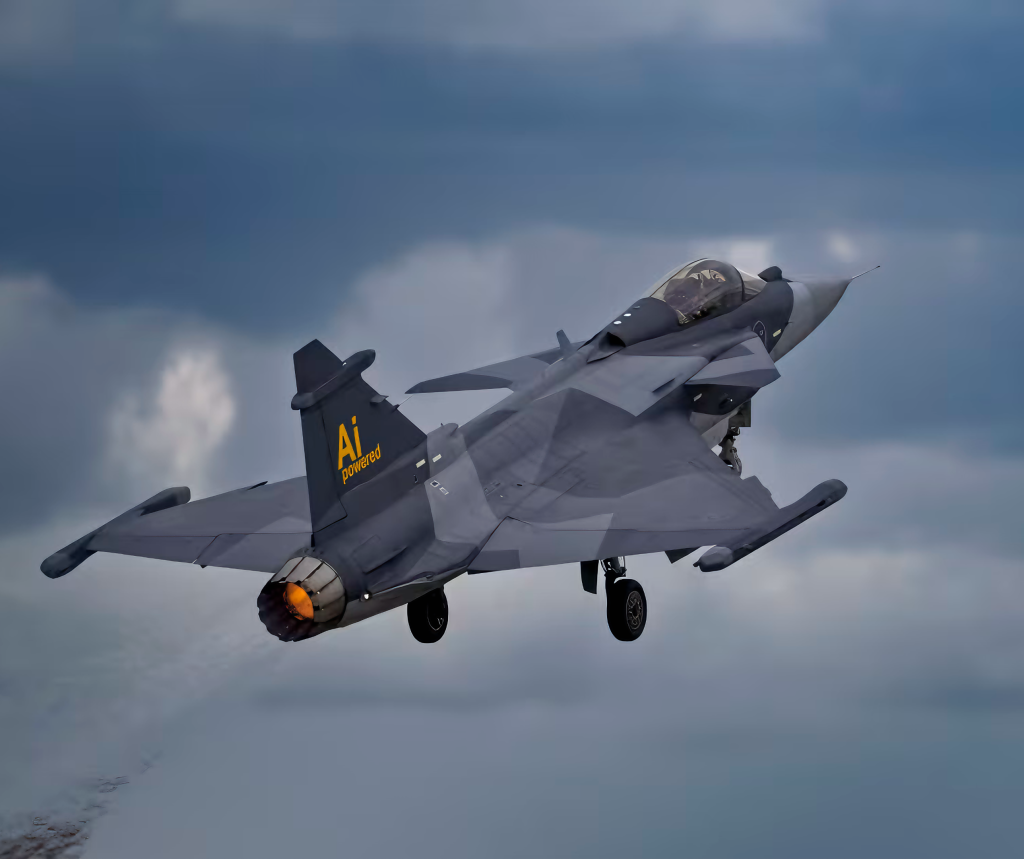
From its early days, the Gripen integrated data links, modular avionics, and sensor fusion, allowing multiple Gripens to share radar data in real-time. This wasn’t just a technological feat—it was a strategy. With limited numbers, Sweden needed every fighter to act as a force multiplier. The result? A fighter that may not dominate every stat sheet but punches way above its weight in the air.
Global Export and Evolution
Sweden wasn’t alone in recognizing the Gripen’s value. Over the past two decades, the aircraft has been exported to several nations, including Hungary, the Czech Republic, South Africa, Brazil, and Thailand. Each of these deals followed a familiar theme: countries looking for modern capabilities without the astronomical costs associated with American or Russian jets.
It also didn’t hurt that Saab offered generous technology transfers—particularly attractive to countries like Brazil, which co-developed the newer Gripen E/F variants.
Speaking of which: the Gripen isn’t standing still. The latest versions—collectively known as the Gripen E (single-seat) and F (two-seat)—are a significant leap forward. They feature:
-
A more powerful General Electric F414 engine
-
AESA radar for improved tracking
-
IRST (Infrared Search and Track) for passive detection
-
Expanded payload capacity
-
An electronic warfare suite that makes it nearly untouchable in contested airspace
With these upgrades, the Gripen E can go toe-to-toe with some of the world’s best fourth and even fifth-gen fighters—all while costing significantly less to fly.
David vs. Goliath in a Digital Dogfight
In an era dominated by heavyweights like the F-35, Eurofighter Typhoon, and Su-57, one might wonder how the Gripen fits in. It’s smaller, less expensive, and lacks stealth. But don’t count it out.
Here’s what makes the Gripen so relevant in modern air combat:
-
Operating Cost – The Gripen costs $4,700–6,000 per flight hour, compared to the F-35’s $30,000+. That means countries can train more, fly more, and maintain readiness at a fraction of the cost.
-
Upgrade-Friendly – The Gripen’s modular systems allow for quick software and hardware upgrades, keeping it current without major overhauls.
-
Electronic Warfare Dominance – Gripen pilots joke that they “see without being seen.” With one of the most advanced EW suites in the world, it can jam radars, spoof missiles, and fly “invisible” in contested environments.
-
Multi-role Mastery – It switches between air-to-air, ground attack, and recon roles mid-mission. That’s not a gimmick—that’s real battlefield flexibility.
-
Interoperability – NATO-compliant but neutral-friendly, Gripen seamlessly fits into allied networks without being tied to U.S. or Russian politics.
Sweden’s Silent Strength
The Gripen also reflects something deeply Swedish: a sense of pragmatic excellence. It doesn’t shout. It doesn’t demand attention. It quietly performs, often better than aircraft that cost twice as much.
This philosophy is mirrored in Sweden’s military posture: defensive, but never unprepared. Neutral, but always vigilant. The Gripen is their guardian in the sky—lean, smart, and ready to respond within minutes.
During recent geopolitical tensions—particularly around the Baltic Sea and Arctic regions—Gripens have been on constant alert. Russian aircraft testing Swedish airspace have been met with fast, efficient intercepts. The Gripen doesn’t need to show off; it just does its job.
A Fighter for the Future
As we look to the next generation of air combat—one that involves drones, hypersonic missiles, and AI-assisted targeting—the Gripen is already adapting. Saab’s roadmap includes:
-
AI-enhanced cockpit systems
-
Swarming drone compatibility
-
Cyber-defense features
-
Seamless integration with both manned and unmanned assets
The Gripen E/F variants are expected to remain in service well into the 2040s, and Saab continues to invest in export partnerships. Countries like India, the Philippines, and Colombia have all expressed interest at different times. What makes the Gripen future-proof isn’t just its tech—it’s the idea behind it: build smart, fly smarter.
Conclusion: The Fighter That Chose a Different Path
In a world of increasingly bloated defense programs, the Saab JAS 39 Gripen is a breath of fresh Scandinavian air. It’s not trying to be the flashiest, or the loudest, or the most feared. It’s trying to be effective, reliable, and independent—and in doing so, it’s become one of the most respected fighters in the sky.
It proves that modern warfare isn’t always about who has the most toys, but who uses them best. Sweden, a country of just over 10 million people, built a fighter that rivals those of global superpowers—not by copying them, but by rethinking the very idea of air power. The Gripen is more than a jet. It’s a philosophy in motion.