When people think of World War II aviation, iconic names like the Supermarine Spitfire or the P-51 Mustang usually take center stage. But tucked behind the legends of piston-engine dogfights lies a lesser-known but groundbreaking machine—the Gloster Meteor.
It wasn’t the flashiest aircraft of the war. It didn’t chase Messerschmitt Me 262s across the sky in Hollywood-style duels. But what it did do was usher in a new era of aerial combat. The Gloster Meteor was Britain’s first jet fighter, the only Allied jet to see operational service in WWII, and a symbol of British innovation at a time when the world was teetering between destruction and progress.
The Birth of Jet Propulsion in Britain
The story of the Meteor begins long before it took to the skies. It starts with a quiet genius—Frank Whittle, a Royal Air Force officer and engineer who, in 1930, filed a patent for a jet engine. At the time, few took him seriously. His idea was revolutionary: instead of using a propeller to move air, his engine would compress it, ignite it with fuel, and blast it out the back—creating thrust and unmatched speed.
The British Air Ministry wasn’t quick to act. Funding was tight, and skepticism was high. But Whittle persisted. Eventually, his company, Power Jets Ltd., partnered with the Gloster Aircraft Company, and work began on what would become the Gloster E.28/39, the UK’s first jet-powered aircraft, which successfully flew in 1941.
With that proof of concept, Gloster was given the green light to develop a jet-powered fighter—and the result would be the Meteor.
Designing the Meteor: Form Follows Function
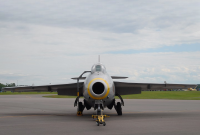
The Gloster Meteor wasn’t about looking pretty. It had a chunky, utilitarian shape, with straight wings and twin turbojet engines mounted in nacelles mid-wing. The design was conservative, meant to avoid the aerodynamic mysteries of swept wings (which weren’t fully understood at the time) and to ensure stability.
It was powered by variations of Whittle’s turbojet design, most notably the Rolls-Royce Welland and Derwent engines. While it couldn’t match the Me 262 in raw speed—it topped out around 410–500 mph, depending on the version—it was remarkably reliable for a first-generation jet.
One of the Meteor’s most defining features was its twin-engine layout. This gave it redundancy—if one engine failed, the aircraft could limp home. For pilots breaking the sound barrier of technology, this safety net was invaluable.
First Flights and Teething Problems
The Meteor prototype first flew on March 5, 1943, piloted by Michael Daunt, Gloster’s chief test pilot. The initial test flights were promising, but as with any bleeding-edge technology, there were problems: compressor stalls, flameouts, engine surges, and control issues.
The British government, however, was determined to get the Meteor into service. The Luftwaffe had already deployed its Me 262, and the Allies couldn’t afford to fall behind in the race for air superiority. Every day counted.
Into the Fight: World War II Service
The Meteor F.1 entered operational service with the Royal Air Force’s No. 616 Squadron in July 1944. But contrary to popular belief, the Meteor didn’t go hunting for German jets in high-speed dogfights. Instead, its early missions were more humble—but no less important.
The RAF deployed Meteors primarily to counter the V-1 flying bombs, the infamous “buzz bombs” launched by Germany against British cities. The Meteor’s speed made it one of the few aircraft fast enough to intercept them. Pilots quickly learned to use the aircraft’s sturdy design to literally tip the V-1’s wings midair, sending them crashing to the ground.

In its first months of service, the Meteor claimed over a dozen V-1 kills, proving its worth and providing British morale with a much-needed boost.
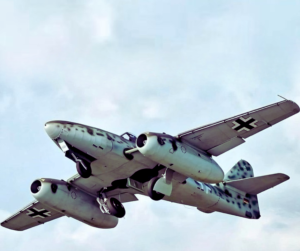
Ironically, the Meteor and the Me 262—two of the most advanced aircraft of the war—never met in combat. The Allies were cautious about deploying their jet too close to the front lines, fearing one might be shot down and captured. As a result, most of the Meteor’s wartime use remained limited to home defense and later operations in Belgium in early 1945.
A Jet in Peacetime: Meteor’s Expanding Role
While the Gloster Meteor arrived too late to change the course of the war, it was far from a footnote. In fact, the Meteor played a vital post-war role—serving in numerous air forces around the world and acting as a bridge between piston and supersonic flight.
Post-1945, Gloster improved the Meteor into the F.3, F.4, and F.8 variants, with more powerful engines, better aerodynamics, and advanced weaponry. The Meteor F.8 was perhaps the definitive version—faster, more agile, and equipped with an ejection seat (a rarity at the time).
Throughout the late 1940s and 1950s, the Meteor served as the backbone of the RAF’s frontline fighter fleet. It was used in training, ground attack, reconnaissance, and even experimental programs.
One of the Meteor’s more bizarre adaptations was the “Prone Pilot” testbed, which reconfigured the cockpit to have the pilot lying face-down, aiming to reduce the effects of G-forces at high speed. Another variant was used to test ejection seats, including by legendary test pilot Eric “Winkle” Brown.
Combat Around the World
Beyond Britain, the Meteor saw service in over a dozen countries, including Australia, Argentina, Egypt, France, Israel, and Brazil. It saw combat in several postwar conflicts, most notably:
-
The Korean War, where the Royal Australian Air Force (RAAF) flew Meteors in combat against North Korean MiG-15s. While the Meteor could hold its own in ground attack, it was outclassed in dogfights by the MiG, prompting a shift in tactics.
-
The 1956 Suez Crisis, where British and French Meteors flew ground-attack and reconnaissance missions.
-
Middle East conflicts, where Israeli Meteors squared off against Arab air forces during escalating regional tensions in the 1950s and ’60s.
Even in these roles, the Meteor was a valuable asset—not as a cutting-edge fighter, but as a dependable multirole platform. It aged gracefully in a world that was evolving faster than ever.
Breaking Records and Setting Milestones
The Meteor wasn’t just a warplane—it was a pioneer. It broke speed records, set altitude records, and pushed human flight into the future.
In 1945, a specially modified Meteor set a world airspeed record of 606 mph (975 km/h). Later models experimented with afterburners, rocket-assisted takeoffs, and aerodynamic tweaks that informed the design of future aircraft like the English Electric Canberra and Gloster Javelin.
Test pilots flying the Meteor were among the first to explore the limits of high-subsonic flight, just shy of the sound barrier, which remained elusive until Chuck Yeager’s flight in 1947.
The lessons learned from the Meteor—about jet engines, pressurization, aerodynamics, and materials—directly influenced the next generation of jet fighters in the UK and abroad.
Legacy of the Meteor
Today, the Gloster Meteor occupies a special place in aviation history. It wasn’t the flashiest or the fastest. It didn’t have the swept wings or the high drama of its German counterpart, the Me 262. But the Meteor did something no other Allied jet managed during WWII: it flew in combat, it won, and it lived to evolve.
The Meteor represents the courage to leap into the unknown. Britain, battered by years of war, still had the foresight to invest in technology that looked beyond the current conflict. That investment paid off—not in decisive battlefield victories, but in decades of jet-powered progress.
The aircraft also highlights a transition—not just technologically, but culturally. Pilots trained on piston Spitfires had to relearn their instincts for jet flight. Engineers had to build new tools, new engines, and new theories. The Meteor was a bridge to a new world.
Where Are They Now?
A number of Gloster Meteors survive in museums around the world. A few are even still flying, maintained by historic aircraft groups in the UK and Australia. Seeing one in the air is like watching history break the sound barrier.
If you ever visit the Royal Air Force Museum in London or Duxford’s Imperial War Museum, take a moment to stand beneath the Meteor’s wide wings. Think about the engineers in the 1930s who dreamed in turbojet, and the pilots in the 1940s who flew into an entirely new era.
Conclusion: The Unsung Hero of the Jet Age
The Gloster Meteor may not grab headlines the way the Spitfire or the Me 262 does, but its importance in the history of aviation is undeniable. It was a practical jet in a time of propeller-driven dreams, and it laid the foundation for everything that came after.
While others reached for glory, the Meteor delivered consistency, reliability, and evolution. In the fast-changing skies of the mid-20th century, it was a constant—always just ahead of its time, always pushing the envelope.
As the first of its kind, the Meteor didn’t just fly—it took the world with it.