The Republic P-47 Thunderbolt, affectionately nicknamed the “Jug,” was the largest and heaviest single-engine fighter to see widespread service in World War II—and one of the most versatile. Born from Alexander Kartveli’s design work at Republic Aviation, the P-47 combined a massive Pratt & Whitney R-2800 radial engine, a rugged airframe, heavy armament, and an efficient turbocharger system to create an aircraft equally deadly in air-to-air combat and in the ground-attack role.
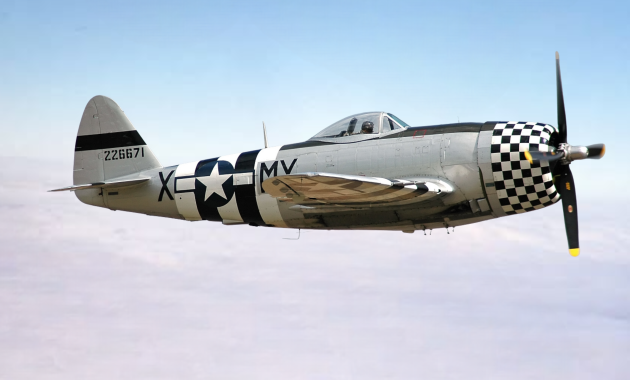
Its size and weight belied surprising performance: high top speed, excellent dive characteristics, and a service ceiling that allowed it to operate comfortably at the altitudes where bomber escort and interceptor work took place. These qualities made the Thunderbolt a mainstay of U.S. Army Air Forces operations in both Europe and the Pacific between 1942 and 1945.
Design and powerplant
At the heart of the P-47 was the Pratt & Whitney R-2800 Double Wasp—an 18-cylinder, two-row radial engine that, in later P-47D variants, produced in the neighborhood of 2,000–2,430 horsepower depending on model and rating. That power, coupled with an advanced turbocharger and intercooler installation, let the Thunderbolt maintain power far above sea level—giving it a real advantage in high-altitude fighting and escort missions. The turbo-supercharging system added bulk and complexity, which contributed to the P-47’s large fuselage cross-section and overall heft, but it paid off in excellent high-altitude capability and a service ceiling around 40,000+ ft.
The airframe itself was built for toughness. The P-47’s structure and armor protection around the cockpit, combined with self-sealing fuel tanks, meant the aircraft could absorb a surprising amount of damage and still bring its pilot home—an attribute that earned it a reputation among crews as exceptionally survivable. The “bubble canopy” introduced on later models improved pilot visibility, especially in the fighter-bomber environment where spotting ground targets and friendly forces mattered.
Armament and payload
Unlike many lighter fighters that prioritized maneuverability above all, the P-47 was designed with firepower and payload in mind. Standard armament typically consisted of eight .50-caliber (12.7 mm) M2 Browning machine guns—four per wing—giving the aircraft an extraordinary weight of fire for strafing or aerial combat. For ground-attack missions the Thunderbolt could carry up to 2,500 pounds of bombs or a combination of bombs and rockets, and most units regularly employed RP-3 rockets or American unguided rockets to devastating effect against enemy armor, rail, and supply lines.
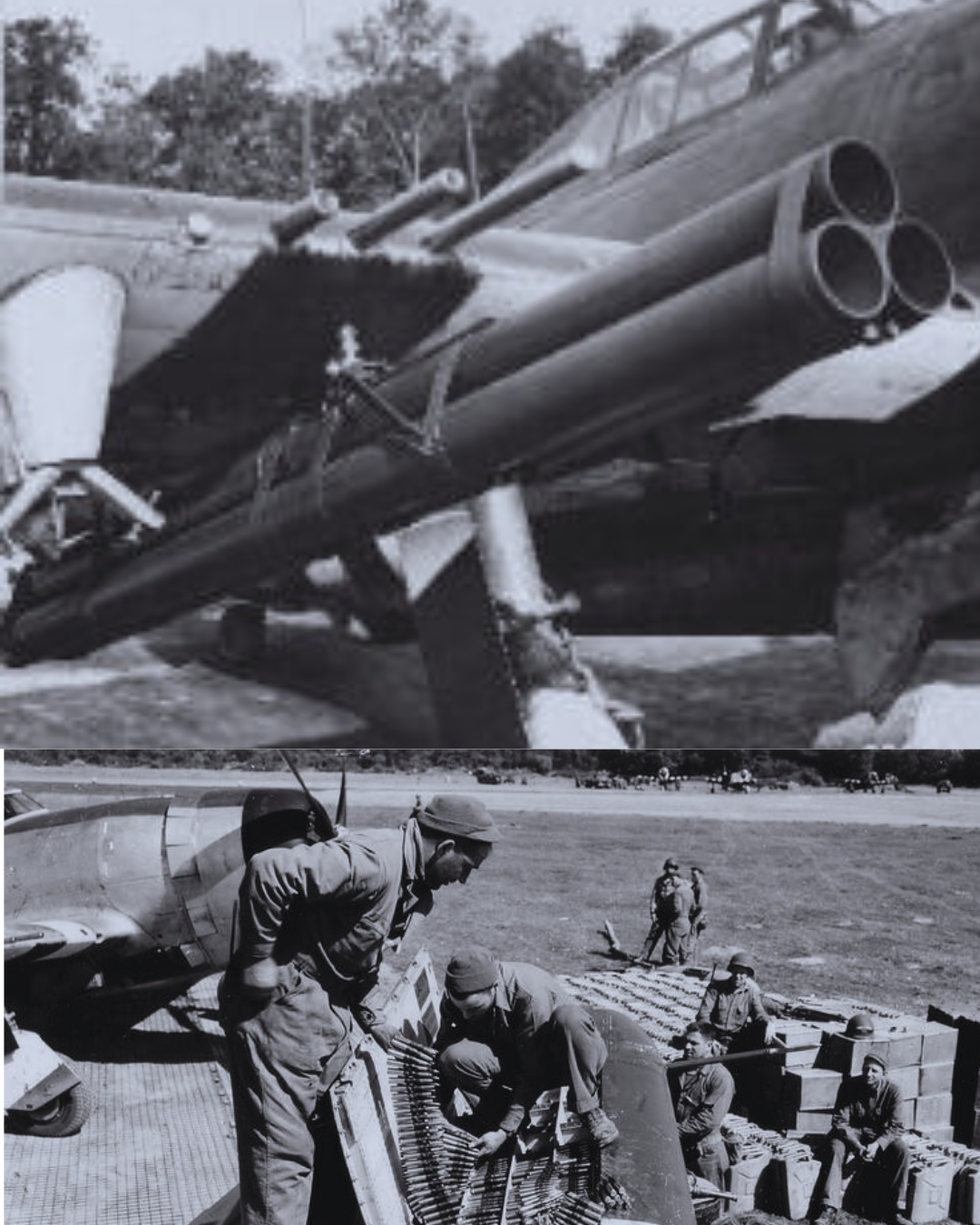
This armament flexibility helped the P-47 transition from high-altitude escort and interceptor roles into the premier Allied fighter-bomber in late-war operations.
Performance and handling
Top speeds for late-model P-47Ds were typically reported in the low-to-mid 400 mph range (roughly 420–433 mph depending on source and altitude), and the type possessed excellent diving stability—an advantage that made it a dangerous opponent in boom-and-zoom engagements where energy retention was key. The aircraft’s weight translated into relatively high wing loading compared with lighter contemporary fighters, which reduced instantaneous turn rate.
Pilots often exploited the P-47’s strengths—speed, diving acceleration, ruggedness and firepower—rather than trying to out-turn lighter opponents. In theater, this translated to tactics emphasizing slashing attacks, high-speed passes, and use of altitude to trade potential energy for decisive strikes.
Operational use
In the European Theater the P-47 initially served as a high-altitude escort for bombers and as an air superiority fighter. As longer-range escort fighters (notably the P-51 Mustang) arrived in force, the Thunderbolt increasingly specialized in ground-attack work, where its durability and loadout made it invaluable. P-47s operated in the famous “cab-rank” close air support method—circling as airborne artillery and being called in by forward controllers to strike armor, road convoys, and troop concentrations—work that helped Allied ground advances after D-Day.
You May Like To Read: Focke-Wulf Fw 190, The “Butcher Bird” That Redefined WWII Air Combat.
The RAF also used Thunderbolts, often in the fighter-bomber role, and many other Allied air forces flew it in various postwar capacities. In the Pacific the P-47 saw action as well, proving effective against Japanese aircraft at medium to high altitudes and devastating in fighter-bomber sorties where its toughness and heavy armament were decisive. Some foreign air forces kept P-47s in service late into the 1940s and 1950s—testimony to the design’s longevity.
Production and variants
More than 15,600 P-47s were produced between 1941 and 1945, making it one of the most numerous American fighters of the war. Production started with earlier “razorback”-style fuselages and cockpit enclosures; later models adopted the bubble canopy for improved rearward visibility and pilot situational awareness. Multiple production blocks and factory modifications produced dozens of subvariants—some optimized for high-altitude interception, others for ground-attack duties with reinforced hardpoints and more fuel.
| Type | Number Built / Converted | Remarks |
|---|---|---|
| XP-47 | 0 | Lt. interceptor (canceled) |
| XP-47A | 0 | Modified XP-47; no guns or radios |
| XP-47B | 1 | Improved P-44 and XP-47 design |
| P-47B | 171 | First prod. aircraft; eight .50-cal. in wings |
| P-47CC | 602 | Improved P-47B |
| P-47D-RE | 3,963 | Razorback P-47D; Blocks 1-22 |
| P-47D-RE | 2,546 | Bubble canopy P-47D; Blocks 25-30 |
| P-47D-RA | 2,350 | Evansville, Ind., plant; Blocks 2-23 |
| P-47D-RA | 3,743 | Evansville bubble canopy; Blocks 26-40 |
| XP-47E | 1 (cv) | Modified B (171st built); press. cockpit |
| XP-47F | 1 (cv) | Modified P-47B; laminar flow wing |
| P-47G-CU | 354 | Curtiss-built D model |
| XP-47H | 1 (cv) | Modified P-47D; 16-cylinder Chrysler engine |
| XP-47J | 1 | New model; six .50-cal. |
| XP-47K | 1 (cv) | Modified P-47D with Hawker Typhoon Cnpy. |
| XP-47L | 1 (cv) | Modified P-47D-20 |
| YP-47M | 3 (cv) | Modified P-47D; dive brakes |
| P-47M | 130 | High-speed version |
| XP-47N | 1 | Improved D; new wing |
| P-47N-RE | 1,667 | Long-range escort model |
| P-47N-RA | 149 | 5,934 canceled after VJ-Day |
Republic built the bulk of the fleet, with additional production by contractors such as Curtiss during peak demand.
Famous features and nicknames
Pilots and ground crews gave the P-47 several nicknames. “Jug” is the best known—short for “Juggernaut” or because the fuselage shape suggested a milk-jug silhouette to some observers. The aircraft also gained a reputation for a loud, distinctive whine from the turbocharger and for a knock-down, blast-heavy firing pattern from its eight .50s. These traits, combined with demonstrated resilience to enemy fire, helped build a mythos of the P-47 as a “bring-them-home” airplane—tough, heavily armed, and reliable.
The P-47 legacy
The Thunderbolt’s historical importance comes from its sheer adaptability. Designed when doctrine still emphasized high-altitude performance, it nevertheless found its greatest niche as a ground-attack workhorse—an evolution driven by the changing needs of the Allied campaigns. Its survivability saved many pilots’ lives; its heavy armament and bomb/rocket capacity helped blunt Axis logistics and armor; and its mass production ensured that Allied commanders had the numbers to dominate contested skies and contested ground.
Postwar, the P-47 served with a number of foreign air forces, bridging the gap into the jet age for many nations. Museums in the United States and around the world preserve flying examples and static displays so new generations can hear the Double Wasp roar and appreciate the machine that did so much for the Allied victory.