MilitaryAndTech.com- Built as the pride of Nazi Germany’s navy, Bismarck was one of the most powerful battleships ever constructed in Europe. Her brief operational career lasted only a matter of days, yet she became one of the most famous warships in history. The dramatic pursuit that ended with her destruction in May 1941 remains one of the greatest naval stories ever told: a tale of engineering ambition, fierce combat, relentless pursuit, and ultimate tragedy.
The Origins of Bismarck
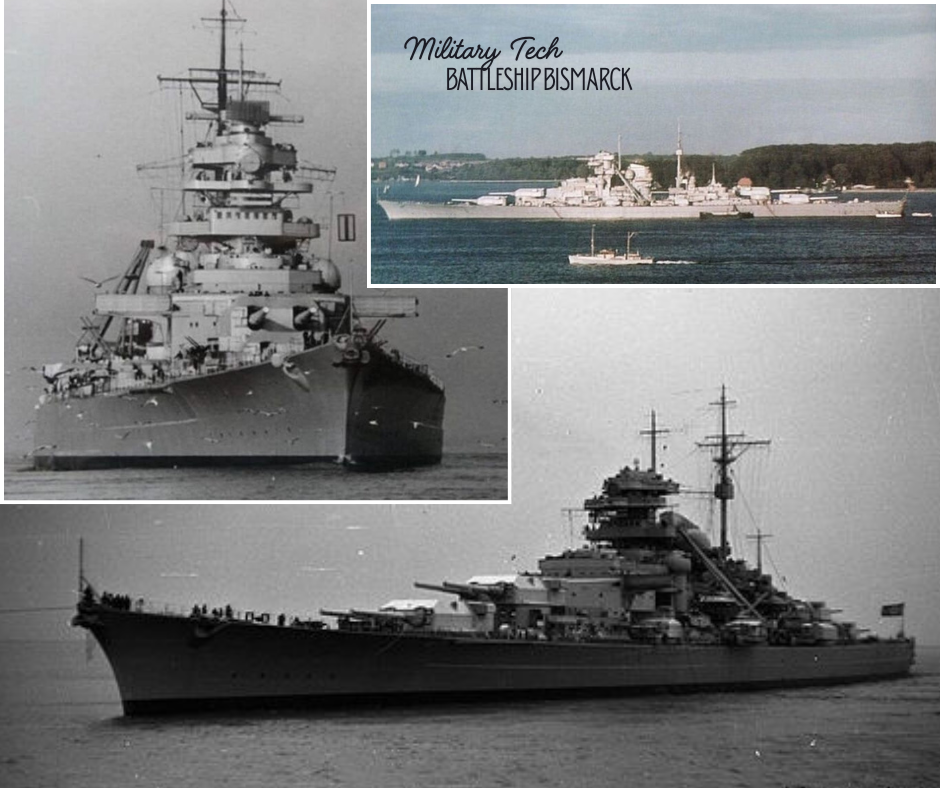
The story of Bismarck began in the years following World War I. Under the terms of the Treaty of Versailles, Germany was heavily restricted in the size and capabilities of its navy.
For years, the German fleet remained a shadow of its former self.
Everything changed when Adolf Hitler came to power in 1933. Determined to restore German military strength, the Nazi government launched an ambitious naval expansion program.
German naval planners sought a fleet capable of challenging Britain and protecting German interests across the Atlantic.
The result was the Bismarck class, consisting of two ships:
- German battleship Bismarck
- German battleship Tirpitz
Named after German statesman Otto von Bismarck, the ship was intended to symbolize Germany’s return as a major naval power.
Development and Construction
Bismarck was laid down at the Blohm & Voss shipyard in Hamburg on 1 July 1936. She was launched on 14 February 1939 and commissioned into the Kriegsmarine on 24 August 1940.
At the time of her completion, she was among the largest and most powerful battleships ever built.
Key Specifications
- Full-load displacement: approximately 50,300 tons
- Length: 251 meters (823 feet)
- Beam: 36 meters (118 feet)
- Maximum speed: over 30 knots
- Crew: approximately 2,200 officers and sailors
Her size alone was impressive, but her real strength lay in the combination of armor, firepower, and speed.
What Made Bismarck Special?
German naval architects sought a balanced design rather than simply building the biggest battleship possible.
Powerful Main Guns
Bismarck carried eight 15-inch (380 mm) guns mounted in four twin turrets.
These weapons could fire shells weighing around 800 kilograms over distances exceeding 35 kilometers. Their accuracy and destructive power made Bismarck a formidable opponent against any battleship of the era.
Exceptional Protection
One of Bismarck’s greatest strengths was her armor.
The ship featured:
- Thick armored belt protection
- Heavily armored gun turrets
- Extensive internal compartmentalization
- Advanced underwater protection systems
German designers prioritized survivability, creating a vessel capable of absorbing enormous punishment while continuing to fight.
High Speed
Despite her massive size, Bismarck could exceed 30 knots.
This speed allowed her to outrun many enemy battleships while retaining the firepower needed to defeat them. The combination of speed, armor, and heavy guns made her one of the most balanced capital ships ever constructed.
Training and Early Service
Following commissioning in August 1940, Bismarck spent several months conducting sea trials and crew training in the Baltic Sea.
The Kriegsmarine viewed her as the centerpiece of its surface fleet. German naval leaders hoped she would help disrupt Britain’s maritime lifelines by attacking merchant shipping in the Atlantic.
You May Like To Read: Everything You Need To Know About HMS Warspite.
However, by 1941 Germany faced a serious challenge. Britain’s powerful Royal Navy controlled much of the world’s oceans. Any German battleship venturing into the Atlantic would likely face intense opposition.
Operation Rheinübung
In May 1941, Bismarck embarked on her first and only combat mission.
The operation, known as Operation Rheinübung, paired Bismarck with the heavy cruiser German cruiser Prinz Eugen.
Their objective was to break into the North Atlantic and attack Allied merchant convoys supplying Britain.
On 19 May 1941, the two ships departed occupied Norway and headed toward the Atlantic.
The mission immediately attracted British attention.
British intelligence detected German movements, prompting the Royal Navy to launch a massive effort to intercept the raiders.
The Battle of the Denmark Strait
On the morning of 24 May 1941, one of the most famous naval battles of World War II unfolded in the Denmark Strait between Greenland and Iceland.
British forces sent two major warships to intercept the Germans:
- HMS Hood
- HMS Prince of Wales
Hood was the pride of the Royal Navy and one of the most famous warships in the world.
As the opposing fleets closed range, Bismarck opened fire.
Only minutes into the battle, a shell from Bismarck—or possibly a shell directed by her fire-control team—penetrated Hood’s vulnerable deck armor and detonated near her magazines.
The result was catastrophic.
A massive explosion ripped Hood apart. The battlecruiser broke in two and sank within minutes.
Of her crew of 1,418 men, only three survived.
The destruction of Hood shocked Britain and instantly made Bismarck the most wanted ship in the world.
The Pursuit of Bismarck
Despite her victory, Bismarck had not escaped unscathed.
A shell from Prince of Wales damaged fuel tanks in the German battleship, causing a leak that would ultimately prove fatal.
Recognizing the danger, German commander Admiral Günther Lütjens decided to head toward occupied France for repairs.
The Royal Navy responded with one of the largest naval hunts in history.
British forces included:
- Battleships
- Aircraft carriers
- Cruisers
- Destroyers
- Coastal patrol aircraft
The British Admiralty issued a clear objective:
Sink Bismarck at all costs.
The Turning Point
For a brief period, Bismarck appeared to have escaped.
Then a British reconnaissance aircraft rediscovered her.
The crucial blow came on 26 May 1941 when torpedo bombers launched from the aircraft carrier HMS Ark Royal attacked.
One torpedo struck near Bismarck’s stern.
The hit jammed her rudders, leaving the battleship unable to steer properly.
Although her engines remained operational, she could only sail in large circles.
The mighty battleship was now trapped.
The Final Battle
During the morning of 27 May 1941, British battleships caught up with the crippled German vessel.
The attackers included:
- HMS King George V
- HMS Rodney
What followed was one of the most one-sided battleship engagements in naval history.
For nearly two hours, British ships pounded Bismarck with hundreds of heavy shells.
Her gun turrets were gradually knocked out.
Her superstructure was wrecked.
Most of her crew became casualties.
Yet Bismarck refused to sink.
Even after suffering catastrophic damage, her armored hull remained afloat.
Eventually, German survivors opened scuttling valves while British torpedoes delivered additional damage.
At approximately 10:40 a.m. on 27 May 1941, Bismarck rolled over and sank.
More than 2,000 German sailors perished.
Only about 115 crew members survived.
Why Bismarck Became a Legend
Although her operational career lasted barely nine days, Bismarck achieved lasting fame for several reasons.
The Sinking of Hood
The destruction of Britain’s most famous battlecruiser instantly transformed Bismarck into a legendary warship.
The Massive Pursuit
Few ships in history have been hunted by such a large concentration of naval forces.
Extraordinary Durability
Bismarck absorbed tremendous punishment before sinking, demonstrating the strength of her design and construction.
Symbol of the Battleship Era
Her final battle represented the peak of traditional battleship warfare, occurring just as aircraft carriers were beginning to dominate naval combat.