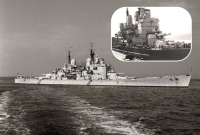
MilitaryAndTech.com- Few warships in history have captured the imagination of historians and naval enthusiasts quite like the Yamato. Built by the Imperial Japanese Navy during the Second World War, Yamato was the largest and most heavily armed battleship ever constructed.
Designed to counter the industrial might of the United States, she embodied Japan’s belief that superior quality could overcome numerical disadvantage. Yet despite her immense size and firepower, Yamato’s career ultimately demonstrated the decline of the battleship era and the rise of naval aviation.
Development: Building the Ultimate Battleship

The origins of Yamato can be traced to the 1930s, when Japan withdrew from international naval limitation treaties and began planning a new generation of capital ships. Japanese naval strategists understood that the United States possessed a far larger industrial base and could outbuild Japan in any prolonged conflict.
As a result, the Imperial Japanese Navy pursued a different strategy: build battleships so powerful that each one could defeat several enemy battleships in combat.
The result was the Yamato-class battleship program. Designers envisioned a vessel with unprecedented armor protection and the largest naval guns ever mounted on a warship. Construction of Yamato began at the Kure Naval Arsenal on 4 November 1937 under extraordinary secrecy.
Shipyard facilities had to be expanded, docks deepened, and massive cranes installed to handle the enormous armor plates and gun turrets.
Parts of the construction area were even concealed from public view to prevent foreign intelligence from learning about the project.
Yamato was launched on 8 August 1940 and officially commissioned on 16 December 1941, only days after the Japanese attack on Pearl Harbor. At full load, she displaced nearly 72,000 tons, making her the heaviest battleship ever completed. Her main armament consisted of nine 46-centimeter (18.1-inch) Type 94 guns mounted in three triple turrets. These were the largest guns ever fitted to a warship, capable of firing massive shells weighing over 1,400 kilograms to ranges exceeding 40 kilometers.
Technical Features
Yamato represented the peak of battleship design. Her armor belt reached up to 410 millimeters in thickness, while her heavily protected gun turrets and armored deck were intended to withstand hits from enemy battleships. The ship was powered by twelve Kampon boilers and steam turbines producing nearly 150,000 horsepower, allowing a top speed of approximately 27 knots.
You May Like To Read: Everything You Need To Know About The HMS Queen Elizabeth.
In addition to her main battery, Yamato carried a powerful secondary armament and increasingly large numbers of anti-aircraft weapons as the war progressed. By 1945, her anti-aircraft defenses had been dramatically expanded in response to the growing threat posed by American carrier aircraft. Nevertheless, even these improvements proved insufficient against massed air attacks.
Service History
Upon entering service, Yamato became the flagship of the Combined Fleet under Admiral Isoroku Yamamoto. In 1942 she served as the command ship during the Battle of Midway, one of the most decisive naval engagements of the Pacific War. Although Yamato herself saw little direct action during the battle, the Japanese defeat marked a turning point in the conflict and highlighted the growing importance of aircraft carriers over battleships.
For much of her career, Yamato spent time at major naval bases such as Truk, Kure, and Brunei. Japanese commanders were reluctant to risk losing such an expensive and symbolically important warship. As a result, the ship often remained in reserve while carrier forces and aircraft carried the burden of combat operations.
In December 1943, Yamato suffered significant damage when the American submarine USS Skate torpedoed her during transit. The battleship returned to Japan for repairs and modernization, including the installation of additional anti-aircraft guns.
Yamato’s most significant combat operation occurred during the Battle of Leyte Gulf in October 1944, the largest naval battle in history. As part of Vice Admiral Kurita’s Center Force, Yamato engaged American escort carriers and destroyers during the Battle off Samar. Although the Japanese force possessed overwhelming firepower, confusion, aggressive American resistance, and fears of air attack led the Japanese fleet to withdraw. The battle represented one of the few occasions when Yamato’s giant guns were fired against enemy surface ships.
Operation Ten-Go and Final Battle
By early 1945, Japan’s strategic situation had become desperate. As American forces invaded Okinawa, Japanese leaders launched Operation Ten-Go, a final suicide mission intended to demonstrate resistance and inflict damage on Allied forces.
On 6 April 1945, Yamato departed Japan with limited fuel and minimal air cover. The plan called for her to reach Okinawa, beach herself, and serve as a stationary artillery platform. However, American reconnaissance aircraft quickly detected the task force, and hundreds of carrier-based aircraft were dispatched to intercept it.
On 7 April 1945, waves of American bombers and torpedo aircraft attacked Yamato. Despite fierce anti-aircraft fire, the battleship was struck by numerous bombs and torpedoes. As flooding worsened and stability was lost, Yamato suffered a catastrophic magazine explosion visible for miles. She sank with the loss of more than 3,000 crew members. The destruction of the world’s most powerful battleship demonstrated beyond doubt that aircraft carriers had replaced battleships as the dominant force in naval warfare.
Legacy
The legacy of Yamato extends far beyond her combat record. She remains one of the most famous warships ever built and a symbol of both Japanese engineering achievement and wartime ambition. Her immense size, powerful armament, and dramatic final mission have made her a subject of countless books, documentaries, films, and historical studies.
From a military perspective, Yamato illustrates the limitations of investing heavily in battleships at a time when naval aviation was rapidly transforming warfare. Although she represented the pinnacle of battleship technology, her career proved that even the strongest armored warship could not survive concentrated air power without adequate fighter protection.
Today, Yamato is remembered as both a marvel of naval engineering and a powerful lesson in the changing nature of warfare. More than eighty years after her sinking, she continues to fascinate historians and enthusiasts as the ultimate battleship: a giant born at the very moment the age of battleships was coming to an end.