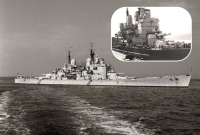
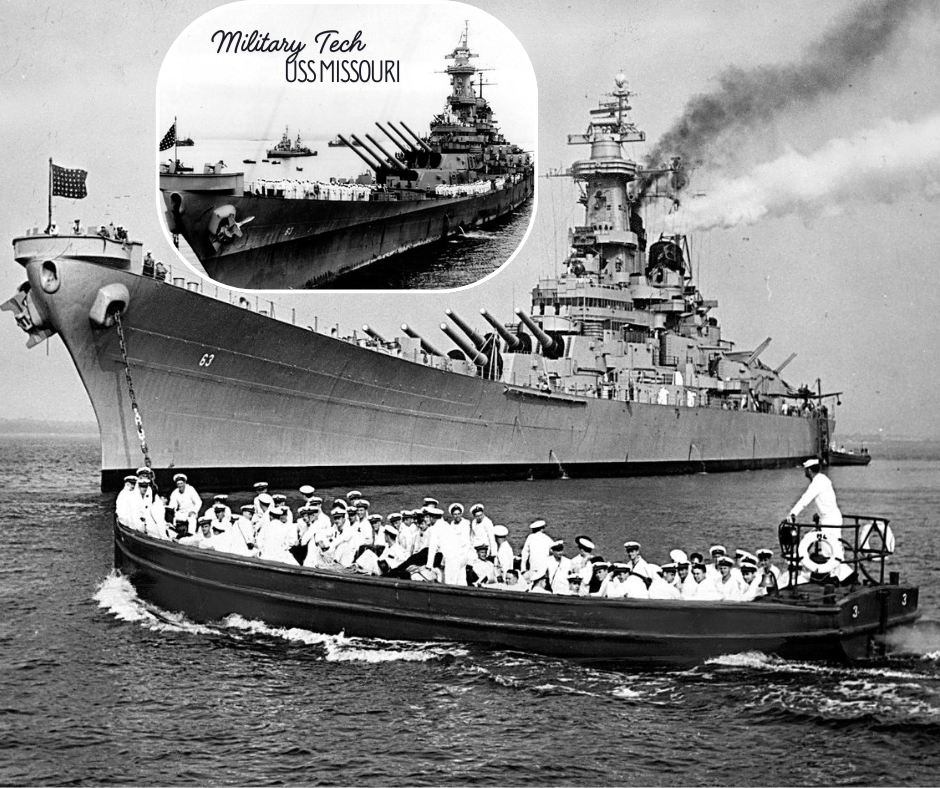
USS Missouri (BB-63), affectionately known as “Mighty Mo,” is one of the most famous warships ever built. As the last battleship commissioned by the United States Navy and the site of Japan’s formal surrender ending World War II, Missouri occupies a unique place in naval history. Yet her story extends far beyond a single historic ceremony.
From fierce combat in the Pacific during World War II to shore bombardment missions in Korea and the Persian Gulf, Missouri served for nearly five decades, demonstrating the enduring power and versatility of the battleship.
Development and Construction
USS Missouri was the fourth and final ship of the Iowa-class battleships, a class designed during the late 1930s as the United States sought fast, heavily armed capital ships capable of escorting aircraft carriers while retaining the firepower to defeat enemy battleships.
The Iowa class represented the culmination of American battleship design. Naval architects sought to combine speed, protection, and firepower in a way no previous battleship had achieved. Unlike earlier battleships that sacrificed speed for armor and armament, the Iowa class was designed to exceed 33 knots, allowing it to operate alongside the Navy’s fast carrier task forces.
You May Like To Read: Everything You Need To Know About Yamato Battleship
Missouri was built by the New York Navy Yard in Brooklyn, New York. Her keel was laid on January 6, 1941, months before the United States entered World War II. She was launched on January 29, 1944, sponsored by Margaret Truman, daughter of then-Senator Harry S. Truman of Missouri. The battleship was commissioned on June 11, 1944, under the command of Captain William M. Callaghan.
At over 887 feet (270 meters) in length and displacing approximately 58,000 tons fully loaded, Missouri was among the largest and most powerful warships ever constructed.
Standout Features
Several characteristics made USS Missouri one of the most formidable battleships in history:
1. Massive Main Battery
Missouri’s most recognizable feature was her nine 16-inch/50 caliber Mark 7 guns, mounted in three triple turrets. These weapons could fire armor-piercing shells weighing up to 2,700 pounds (1,225 kg) at targets more than 20 miles (32 km) away.
The destructive power of a full broadside was staggering. A single salvo could deliver more than 24,000 pounds of steel and explosives toward an enemy target.
2. Exceptional Speed
Unlike many battleships of the era, Missouri could achieve speeds exceeding 33 knots (61 km/h), making her one of the fastest battleships ever built. This speed allowed her to escort aircraft carriers and rapidly reposition during combat operations.
3. Heavy Armor Protection
Missouri carried an armored belt up to 12.1 inches thick and heavily protected turrets and vital spaces. Her armor scheme was designed to withstand hits from enemy battleships while maintaining operational effectiveness.
4. Advanced Fire Control Systems
The ship employed sophisticated radar and fire-control equipment for the period. These systems enabled accurate gunnery during both daylight and nighttime operations, a significant advantage over many wartime opponents.
5. Powerful Anti-Aircraft Defenses
As aircraft became the primary threat at sea, Missouri carried an extensive anti-aircraft battery of 5-inch dual-purpose guns, 40 mm Bofors guns, and 20 mm Oerlikon cannons. These weapons provided layered protection against enemy aircraft.
Service History
Missouri joined the Pacific Fleet in late 1944 and quickly entered combat operations against Imperial Japan.
She participated in carrier task force operations supporting strikes against the Japanese home islands and occupied territories. During these missions, Missouri provided anti-aircraft protection for American carriers while remaining prepared to engage enemy surface ships.
In early 1945, Missouri supported operations related to the invasions of Iwo Jima and Okinawa. Her powerful guns bombarded Japanese positions, helping prepare landing zones for Allied forces.
On April 11, 1945, Missouri survived a kamikaze attack when a Japanese aircraft crashed into her starboard side. Although the impact caused damage and casualties, the battleship remained operational. Captain Callaghan notably ordered that the Japanese pilot receive a military burial at sea, a gesture remembered as an act of respect amid a brutal conflict.
Throughout the final months of the war, Missouri continued operations off Japan, participating in bombardments and carrier escort missions as Allied forces tightened their grip on the Japanese Empire.
The Ship That Ended World War II
Missouri’s most famous moment came on September 2, 1945.
Anchored in Tokyo Bay beneath the shadow of Mount Fuji, Missouri hosted the formal surrender ceremony of Japan. Representatives of the Japanese government and military boarded the battleship and signed the Instrument of Surrender on her deck.
General of the Army Douglas MacArthur presided over the ceremony, while representatives from Allied nations witnessed the historic event. The signing officially ended World War II, the deadliest conflict in human history.
Photographs of the surrender aboard Missouri became some of the most iconic images of the twentieth century.
Because of this event, Missouri is forever associated with the conclusion of World War II.
Korean War Service
Following postwar service, Missouri remained active while many other battleships were placed in reserve.
When the Korean War erupted in 1950, Missouri became the only active American battleship available for immediate deployment.
She conducted extensive shore bombardment missions against North Korean and Chinese positions, using her heavy guns to destroy troop concentrations, railways, bridges, and supply facilities.
The battleship’s firepower proved highly effective in supporting United Nations ground forces. Missouri served multiple combat tours before returning to the United States.
In 1955, amid defense budget reductions and changing naval priorities, Missouri was decommissioned and placed in reserve.
Return During the Cold War
For nearly three decades, Missouri remained inactive in the reserve fleet.
However, during the 1980s, the administration of President Ronald Reagan launched an ambitious naval expansion program aimed at creating a 600-ship Navy.
As part of this initiative, all four Iowa-class battleships were modernized and recommissioned.
Missouri underwent a comprehensive modernization beginning in 1984. While retaining her famous 16-inch guns, she received modern weapons systems including:
- BGM-109 Tomahawk land-attack cruise missiles
- RGM-84 Harpoon anti-ship missiles
- Phalanx Close-In Weapon Systems (CIWS)
- Modern radar and electronic warfare equipment
The upgrades transformed Missouri into a unique blend of World War II battleship firepower and modern missile warfare capability.
She was recommissioned on May 10, 1986.
Operation Desert Storm
Missouri’s final combat service came during the 1991 Gulf War.
During Operation Desert Storm, she launched Tomahawk cruise missiles against Iraqi targets and conducted naval gunfire support missions along the Kuwaiti coast.
Her 16-inch guns once again demonstrated their effectiveness, delivering devastating fire against Iraqi defensive positions.
More than 45 years after World War II, Missouri was still fighting in a major conflict—a remarkable testament to the durability and adaptability of the Iowa-class design.
After the war, changing military priorities and budget considerations led to the retirement of the battleship force.
Missouri was decommissioned for the final time on March 31, 1992.
Legacy
USS Missouri occupies a special place in both American and world history.
She was the last battleship commissioned by the United States Navy and the final battleship ever built by the United States. More importantly, she served as a witness to both the end of World War II and the evolution of naval warfare across nearly half a century.
Today, Missouri is preserved as a museum ship at Pearl Harbor National Memorial in Hawaii, where she is berthed near the wreck of the battleship USS Arizona (BB-39). The location creates a powerful historical connection: Arizona symbolizes America’s entry into World War II, while Missouri symbolizes its conclusion.
Millions of visitors have walked the deck where Japan formally surrendered, making Missouri not merely a preserved warship but a living monument to one of the most significant moments in modern history.