The Gloster Meteor was the first British jet fighter and the only Allied jet to see combat in World War II. Its development, driven by Frank Whittle’s pioneering turbojet engines, began in 1940, with the aircraft taking its first flight in 1943 and entering service in 1944. Though not aerodynamically advanced, the Meteor proved effective in combat. It also made history in 1946 as the world’s first civilian-registered jet aircraft. Over the years, the Meteor evolved through multiple variants and served with the RAF and several other air forces well into the 1950s.
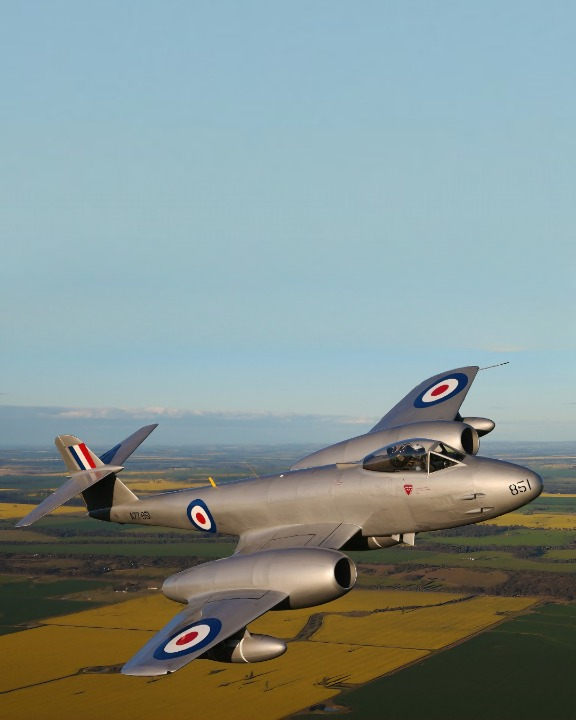
While slower and less heavily armed than Germany’s Me 262, the Meteor still saw limited action in WWII and later served with the Royal Australian Air Force in the Korean War. Countries like Argentina, Egypt, and Israel also operated the Meteor in regional conflicts. Beyond combat, it played a key role in research and broke several aviation records.
Notably, a modified Meteor became the first turboprop aircraft to fly in 1945, and other variants set early jet speed records, reaching over 600 mph. The Meteor’s contributions to military aviation and aerospace innovation were significant and long-lasting.
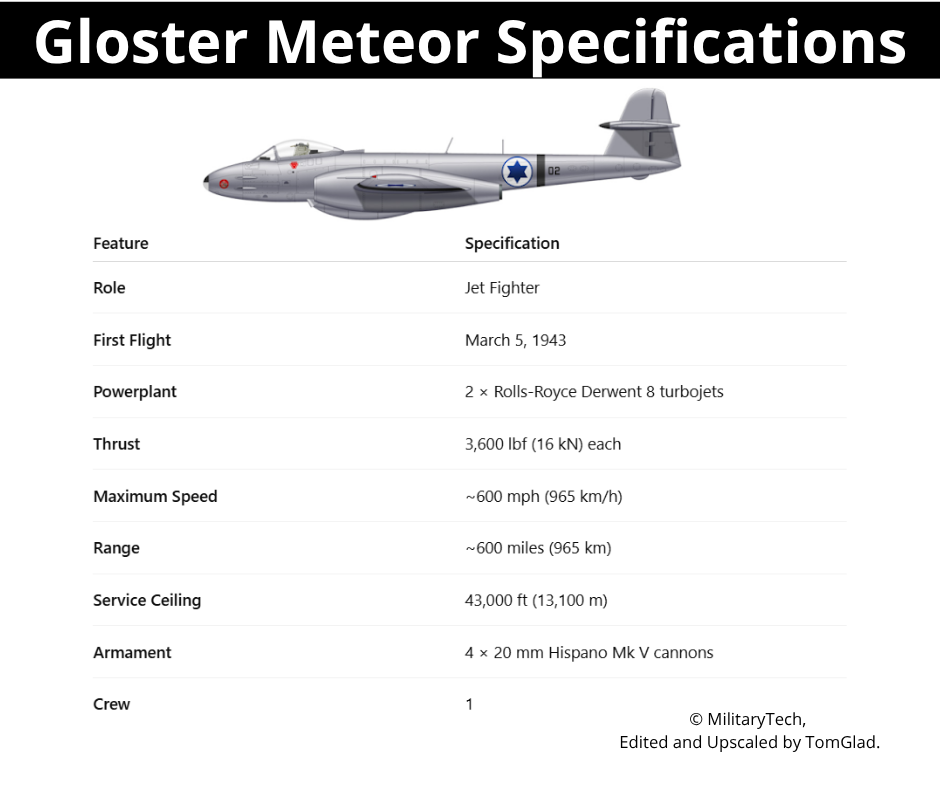
Gloster Meteor Specifications:
The Gloster Meteor F.8 was a refined and powerful version of Britain’s first operational jet fighter, designed for frontline combat in the early jet age. First flown on March 5, 1943, the F.8 featured two Rolls-Royce Derwent 8 turbojet engines, each producing 3,600 pounds of thrust, giving the aircraft a top speed of around 600 mph (965 km/h).
With a range of approximately 600 miles and a service ceiling of 43,000 feet, the F.8 was well-suited for high-speed interception and patrol missions. Armed with four 20 mm Hispano Mk V cannons, it had formidable firepower for both air-to-air and ground-attack roles. Its improved aerodynamics, redesigned tail, and strengthened fuselage made it the most capable and widely produced Meteor variant, flown by a single pilot and serving in numerous air forces around the world during the late 1940s and 1950s.
You May Like To Read: Gloster Meteor: Britain’s Jet-Powered Leap Into the Future.
Gloster Meteor Variants:
The Gloster Meteor’s journey began with the F.1, which holds the distinction of being the first operational jet fighter used by the Allies. It entered service in 1944, offering a revolutionary step forward in aviation technology, though it was still relatively limited in range and refinement. Soon after came the F.3, which featured an improved canopy for better pilot visibility and increased range, making it more suitable for early frontline duties as jet combat rapidly evolved.
Building on these foundations, the F.4 introduced shorter, strengthened wings and upgraded Derwent engines, allowing for greater speed and performance. The real leap forward, however, came with the F.8, the most produced and widely used variant. It included a redesigned tail, improved aerodynamics, and better handling, making it a mainstay in RAF service and beyond during the late 1940s and early 1950s. The F.8 became a symbol of postwar British air power, combining speed, firepower, and reliability.
As the Meteor evolved beyond pure fighter roles, specialized versions were developed. The NF.11 through NF.14 were night fighter variants, equipped with radar and a two-seat configuration, ideal for nocturnal operations during the Cold War era.
The PR.10 served as a photographic reconnaissance aircraft, gathering intelligence at high altitudes. Meanwhile, the T.7, a two-seat trainer, helped prepare pilots for the transition to jet-powered flight. Together, these variants showcased the Meteor’s versatility, adapting to meet a wide range of operational needs across multiple nations and decades.
Gloster Meteor Legacy:
The Gloster Meteor holds a special place in aviation history as the first British jet fighter and the only Allied jet to see combat during World War II. Its successful introduction marked the beginning of the jet age for Britain and influenced the rapid shift away from piston-powered aircraft. While its combat role during WWII was limited, the Meteor served as an essential stepping stone in jet development, proving that turbojet technology was not only viable but essential for the future of air combat.
Beyond the war, the Meteor became a versatile workhorse for the Royal Air Force and several allied nations. With multiple variants tailored for combat, training, reconnaissance, and night interception, the aircraft remained in service well into the 1950s and even 1960s in some air forces. It saw action not just in Europe, but in the Korean War with the Royal Australian Air Force and in various regional conflicts with operators like Israel, Egypt, and Argentina. Its adaptability and reliability solidified its reputation as one of the most important jet aircraft of the early Cold War period.
The Meteor’s influence extended beyond military operations into the realm of aeronautical research and innovation. It set numerous aviation records, including the first official jet-powered airspeed record, and was used in pioneering experiments such as testing turboprop engines, rocket-assisted takeoffs, and even high-altitude pressure suits. Its role in shaping jet propulsion, combat tactics, and pilot training laid the groundwork for generations of jet aircraft to follow. The Gloster Meteor wasn’t just a first—it was a jet that defined an era.