militaryandtech.com- In the high-stakes world of Cold War air defense, speed, altitude, and interception capability were everything. Among the standout machines built to meet this daunting challenge, few have left such a dramatic mark on aviation history as the English Electric Lightning, Britain’s first and only all-British Mach 2 fighter.
A Product of Its Time, and Ahead of It

Developed during the height of Cold War tensions, the Lightning emerged in response to an urgent need: defend the United Kingdom’s airspace against the growing threat of high-speed, nuclear-armed Soviet bombers. Designed by English Electric, which would later become part of the British Aircraft Corporation (BAC), the Lightning was not just another fighter. It was a technological leap.
Entering service in the early 1960s, the Lightning served with distinction through the 1970s and into the late 1980s. Its primary operator was the Royal Air Force (RAF), but the aircraft also saw service with the Kuwait Air Force (KAF) and the Royal Saudi Air Force (RSAF). That global reach was a testament to its effectiveness and appeal.
Designed to Intercept at All Costs
The Lightning was purpose-built as a high-speed interceptor, primarily tasked with defending Britain’s nuclear deterrent, the “V bomber” force, against attack by fast, high-flying Soviet aircraft. Initially envisioned to counter threats like what eventually became the Tupolev Tu-22 “Blinder”, the Lightning’s role expanded to include intercepting other strategic bombers such as the Tu-16 “Badger” and the iconic Tu-95 “Bear”.
This focus on interception above all else led to some truly remarkable design decisions.
The Twin-Engine Marvel: Vertical and Staggered
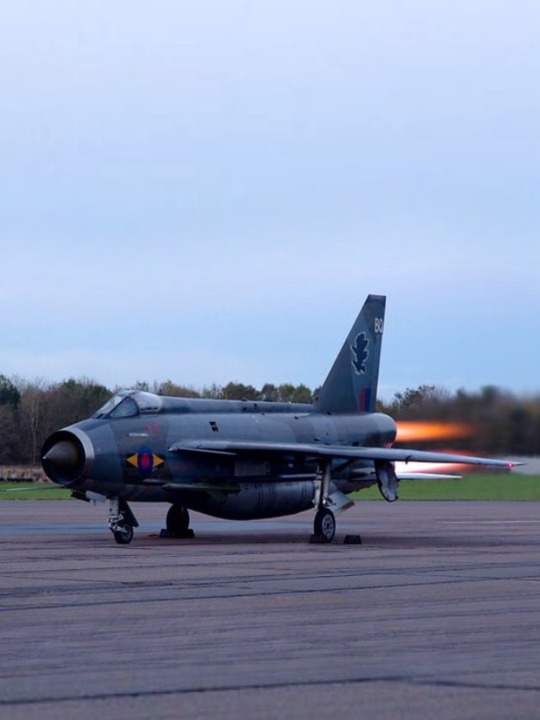
One of the most unique and most talked-about features of the Lightning is its engine configuration. Most twin-engine aircraft place their engines side-by-side under the wings or in nacelles along the fuselage. The Lightning did it differently. It stacked its two Rolls-Royce Avon turbojet engines vertically inside the fuselage, one above the other.
This unusual setup kept the aircraft’s frontal area compact, which minimized drag and boosted speed. It was a bold design choice that worked exceptionally well for the Lightning’s mission.
Blistering Performance
With top speeds above Mach 2, the Lightning was among the fastest aircraft of its generation. It could climb at an astonishing rate. Pilots often described it as “like being strapped to a skyrocket.” In some cases, it could go from takeoff to 36,000 feet in under three minutes. That gave it the ability to respond quickly to any airspace incursion.
Of course, all that performance came at a price. The aircraft had limited range and fuel capacity, thanks to its powerful engines and compact design. This meant missions had to be short, or supported by aerial refueling when possible.
Development and RAF Service
The RAF officially introduced the Lightning into frontline service in 1960 with No. 74 Squadron, based at RAF Coltishall. Its climb rate, top speed, and radar-guided Firestreak missiles made it a perfect fit for its core role—rapid interception of intruding aircraft before they could threaten the UK’s strategic nuclear bombers or civilian population centers.

Over time, several variants were introduced to meet evolving needs:
-
Lightning F.1 / F.1A: The first production models, focused on high-speed interception.
-
F.2 / F.2A: Improved avionics, airframe refinements, and additional fuel capacity.
-
F.3: Featured a more powerful engine and a redesigned nose to house the upgraded radar and new Red Top missiles.
-
F.6: The definitive Lightning variant, with overwing fuel tanks and extended range.
-
T.4 / T.5: Two-seat trainers used to prepare new Lightning pilots.
The RAF deployed Lightnings to airfields in the UK and overseas, particularly in West Germany and Cyprus, where they served as a visible and potent deterrent during the most tense periods of the Cold War.
Despite the introduction of more modern aircraft by the 1980s, the Lightning remained in frontline RAF service until 1988, when it was finally retired and replaced by the Tornado F3. However, its legacy endured, and many RAF pilots continued to speak of the Lightning as one of the most thrilling and challenging aircraft they ever flew.
Legacy and Legend
Despite its limitations, the Lightning earned a legendary status in British aviation history. It was a bold and unmistakable example of cutting-edge engineering. For the RAF, it provided years of dependable service and unmatched speed. For aviation fans, it remains one of the most exciting and visually stunning fighters of the Cold War era.
Today, several Lightnings are preserved in museums or maintained by private collectors. A few are still capable of high-speed taxi runs, thrilling crowds with their signature roar. They are a living reminder of a time when the skies were watched constantly, and one aircraft stood ready to climb fast and meet the threat.