MilitaryAndTech.com– Among the many famous battleships that served during the twentieth century, few occupy a more unique place in naval history than HMS Vanguard. Unlike legendary wartime battleships such as HMS Warspite or Germany’s Bismarck, Vanguard arrived too late to participate in World War II.
Yet she remains historically significant as the largest, fastest, and final battleship ever built for the Royal Navy, and indeed the last battleship completed anywhere in the world.
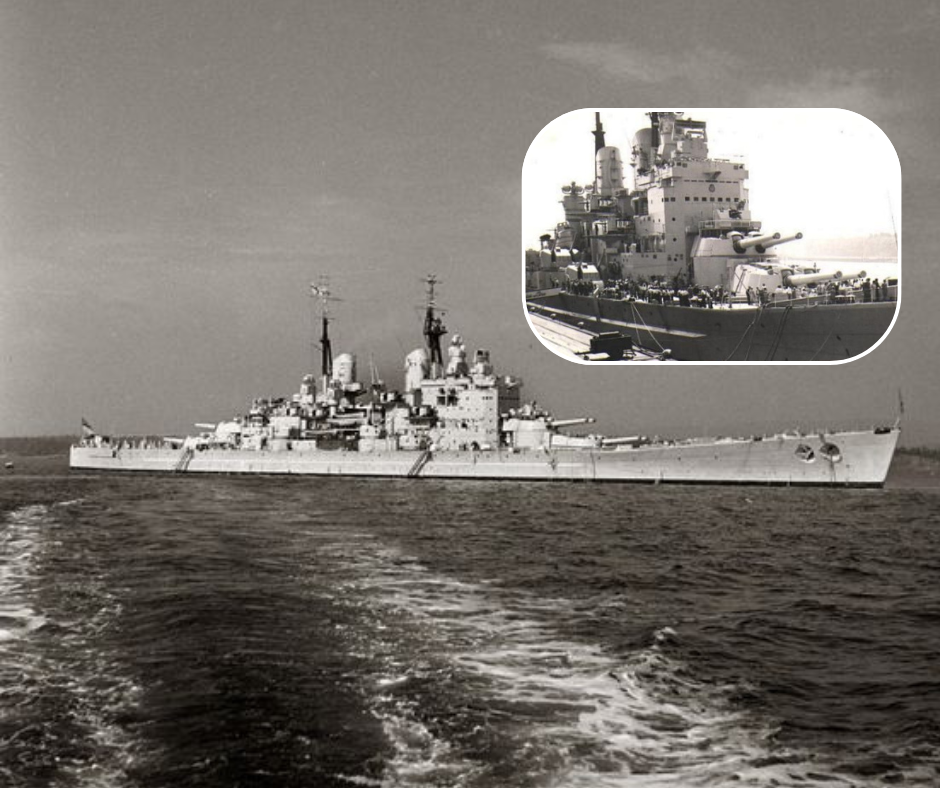
HMS Vanguard represented the ultimate evolution of British battleship design, a ship that combined decades of combat lessons, modern technology, powerful armament, and elegant lines into a single vessel. Although her service career unfolded during the dawn of the Cold War rather than the great naval battles of World War II, Vanguard became a symbol of Britain’s enduring naval tradition and the end of the battleship era.
Origins of the Vanguard Project
The origins of Vanguard can be traced to the tense years before World War II.
By the late 1930s, Britain faced growing naval competition from Germany, Italy, and Japan. New foreign battleships were becoming larger, faster, and more heavily armed. The Royal Navy responded by building the King George V-class battleships, but naval planners knew additional capital ships would eventually be needed.
The outbreak of World War II accelerated these concerns. In 1939 and 1940, reports suggested Germany might soon deploy additional powerful battleships, while Japan was believed to be constructing even larger vessels.
The British Admiralty sought a solution that could be completed quickly.
Rather than designing a completely new battleship from scratch, planners decided to use a set of existing 15-inch gun turrets that had originally served aboard the battlecruisers HMS Courageous and HMS Glorious before those ships were converted into aircraft carriers.
This decision saved years of development and allowed construction to begin more rapidly.
The resulting design became HMS Vanguard.
Development and Construction
Vanguard was laid down at the famous John Brown & Company shipyard at Clydebank, Scotland, on 2 October 1941.
However, wartime priorities soon slowed construction.
Aircraft carriers, escort vessels, landing ships, and merchant vessels were considered more important than a new battleship. As a result, resources and labor were frequently diverted elsewhere.
Construction continued at a reduced pace throughout the war.
By the time the ship neared completion, the strategic situation had changed dramatically. Aircraft carriers had emerged as the dominant force at sea, and the age of battleship supremacy was drawing to a close.
Nevertheless, Britain completed the vessel as a valuable fleet flagship and symbol of national prestige.
Key milestones included:
- Laid down: 2 October 1941
- Launched: 30 November 1944
- Commissioned: 12 May 1946
By the time Vanguard entered service, World War II had already ended.
Design Philosophy
Vanguard was not merely another battleship. She represented the culmination of decades of British naval experience.
Her designers incorporated lessons learned from:
- The Battle of Jutland
- Interwar modernization programs
- World War II combat operations
- Air attack threats
- Advances in radar and fire control
The result was arguably the most refined British battleship ever built.
Specifications
At full load, Vanguard displaced approximately 51,400 tons.
Dimensions
- Length: 248 meters (814 feet)
- Beam: 32.9 meters (108 feet)
- Draft: approximately 11 meters
Propulsion
The ship was powered by:
- Eight Admiralty boilers
- Four Parsons steam turbines
- Four propeller shafts
These produced roughly 130,000 shaft horsepower.
Maximum speed reached approximately 30 knots, making Vanguard the fastest battleship ever operated by the Royal Navy.
Crew
A typical complement exceeded 1,900 officers and sailors.
Armament
1. Main Battery
Vanguard carried eight 15-inch (381 mm) guns mounted in four twin turrets.
Although these guns originated from earlier warships, they had been modernized extensively.
The weapons remained among the most effective heavy naval guns ever built, capable of firing massive shells over distances exceeding 30 kilometers.
Their reliability and accuracy were well proven after decades of Royal Navy service.
2. Secondary Armament
To defend against surface ships and aircraft, Vanguard carried:
- Sixteen 5.25-inch dual-purpose guns
- Numerous Bofors anti-aircraft guns
- Additional close-range anti-aircraft weapons
The dual-purpose guns could engage both ships and aircraft, reflecting lessons learned during World War II.
3. Radar and Fire Control
One area where Vanguard truly excelled was electronics.
She carried some of the most advanced radar systems available in the world during the late 1940s.
These systems allowed:
- Long-range target detection
- Accurate gunfire control
- Air-search capability
- Surface-search capability
Combined with sophisticated fire-control computers, Vanguard could engage targets far more effectively than battleships built only a decade earlier.
4. Protection
Vanguard’s armor scheme reflected decades of combat experience.
Protection included:
- Belt armor up to 13 inches thick
- Heavily armored gun turrets
- Armored decks designed to resist plunging fire
- Improved underwater protection systems
While not the most heavily armored battleship ever built, Vanguard offered an excellent balance between protection, speed, and firepower.
Service History
1. Entering a New Era
When Vanguard entered service in 1946, she found herself in a dramatically different world.
The great naval battles that had defined previous decades were over.
Aircraft carriers had become the primary capital ships of major navies, while nuclear weapons and guided missiles were beginning to reshape military strategy.
As a result, Vanguard never fought in combat.
Nevertheless, she became the flagship of the Royal Navy and performed numerous important peacetime duties.
2. Royal Duties
One of Vanguard’s most famous missions occurred in 1947.
She transported Britain’s royal family on a high-profile tour of South Africa.
The voyage demonstrated both the ship’s reliability and her prestige.
As the Royal Yacht was too small for such a major journey, Vanguard served as an impressive floating symbol of British power and diplomacy.
The deployment became one of the most celebrated peacetime cruises in Royal Navy history.
3. Fleet Flagship
Throughout the late 1940s and early 1950s, Vanguard frequently served as flagship of the Home Fleet.
Her duties included:
- Fleet exercises
- Diplomatic visits
- Naval reviews
- Training operations
- Representation of British interests overseas
Wherever she sailed, Vanguard attracted attention as one of the world’s most impressive warships.
Why Vanguard Never Saw Combat
The simple answer is timing.
Had she entered service in 1942 or 1943, Vanguard would almost certainly have participated in major operations against Germany or Japan.
Instead, she arrived after the war had ended.
More importantly, naval warfare had fundamentally changed.
World War II demonstrated that aircraft carriers could strike enemy ships hundreds of miles away, far beyond the range of battleship guns.
Events such as:
- The attack on Pearl Harbor
- The sinking of HMS Prince of Wales and HMS Repulse
- The Battle of Midway
proved that air power had become dominant.
Battleships still possessed enormous firepower, but they were no longer the centerpiece of naval strategy.
The Last Battleship
What makes Vanguard especially remarkable is her place in history.
She was:
- The last battleship built for the Royal Navy
- The last battleship completed anywhere in the world
- The final expression of traditional battleship design
No nation would ever again complete a new battleship after Vanguard entered service.
Future naval development focused on:
- Aircraft carriers
- Guided missiles
- Nuclear submarines
- Electronic warfare systems
Vanguard effectively marked the end of an era that had begun with HMS Dreadnought in 1906.
Retirement and Scrapping
By the mid-1950s, maintaining large battleships had become increasingly expensive.
The Royal Navy faced budget constraints and rapidly changing strategic priorities.
In 1955, Vanguard was placed in reserve.
Although proposals occasionally surfaced to preserve her as a museum ship, none gained sufficient support.
In 1960, she was sold for scrap.
The dismantling process began shortly afterward, ending the career of Britain’s final battleship.
Many naval historians consider the loss unfortunate, as Vanguard would have been an extraordinary museum vessel.
Legacy
Today, HMS Vanguard remains one of the most fascinating warships ever built, not because of dramatic wartime victories, but because of what she represented.
You May Like To Read: USS Missouri (BB-63): The Last American Battleship
She embodied the ultimate development of British battleship engineering, combining proven firepower, modern technology, excellent speed, and refined design into a single vessel. Had she entered service just a few years earlier, she might have become one of the most famous combat ships of World War II.
Instead, Vanguard became something equally important: a monument to the end of the battleship age.
As the final battleship completed in world history, she stands as the last chapter in a story that began with the great dreadnoughts of the early twentieth century. Elegant, powerful, and technologically advanced, HMS Vanguard remains a symbol of British naval excellence and the closing act of the battleship era.