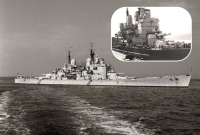
Few warships in history earned a reputation as formidable as HMS Warspite. Serving through both World Wars, surviving some of the fiercest naval battles ever fought, and earning more battle honors than any other Royal Navy ship, Warspite became known simply as the “Grand Old Lady.” Her story is not merely the tale of a battleship: it is the story of the evolution of naval warfare from the age of dreadnoughts to the dawn of guided weapons.
Origins and Development
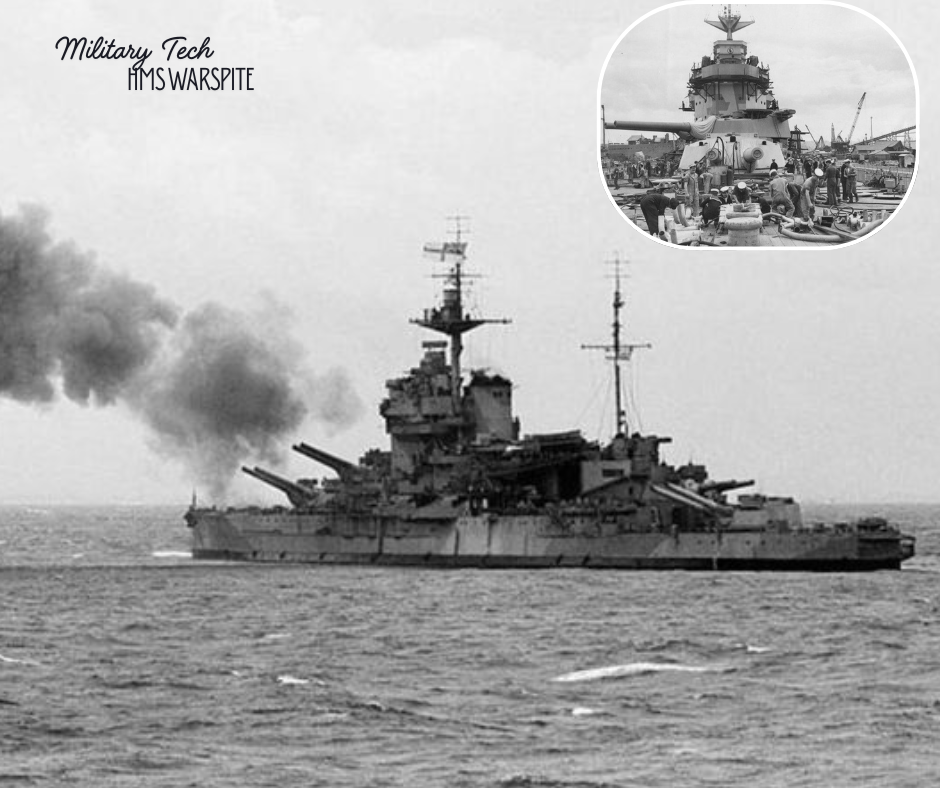
Warspite was one of five ships of the revolutionary Queen Elizabeth-class battleship, a design that transformed battleship construction in the early twentieth century.
Ordered under the Royal Navy’s 1912 naval program, she was laid down at Devonport Dockyard on 31 October 1912, launched on 26 November 1913, and commissioned on 8 March 1915.
The Queen Elizabeth class represented a major leap forward in battleship design. Previous dreadnoughts had emphasized armor and firepower, but these ships introduced a new concept: the fast battleship.
They combined heavy armament with unprecedented speed, allowing them to operate alongside battlecruisers while retaining the protection of a battleship. Their design speed of approximately 24–25 knots made them among the fastest capital ships in the world when completed.
Warspite carried:
- Eight 15-inch (381 mm) guns in four twin turrets
- Heavy belt armor up to 13 inches thick
- Oil-fired boilers instead of coal
- A displacement of over 31,000 tons when fully loaded
The adoption of the 15-inch gun proved especially significant. These weapons would become some of the most successful naval guns ever built, remaining effective throughout both World Wars.
World War I Service
Joining the Grand Fleet
Upon entering service in 1915, Warspite joined the Royal Navy’s Grand Fleet at Scapa Flow. Britain and Germany were engaged in a naval arms race, and the fleet’s primary mission was to contain the German High Seas Fleet.
Warspite’s early career was somewhat troubled. She ran aground and later collided with another battleship, earning an undeserved reputation as an unlucky vessel. Yet these incidents would soon be overshadowed by her performance in the greatest naval battle of the war.
The Battle of Jutland
Warspite’s defining First World War moment came during the Battle of Jutland on 31 May–1 June 1916, the largest naval clash of the war.
Assigned to the 5th Battle Squadron, Warspite and her sister ships brought their powerful 15-inch guns into action against German battlecruisers and battleships. During the battle, a steering malfunction caused her rudder to jam. The ship began making large circles directly under enemy fire. What could have been a disaster instead became an act of accidental heroism.
As Warspite circled, German ships concentrated their fire on her, temporarily diverting attention from other British vessels. She absorbed at least fifteen heavy shell hits, suffering severe damage and significant casualties. Despite the punishment, she remained afloat and eventually managed to return to port under her own power.
The battle cemented Warspite’s reputation for extraordinary toughness. Many ships would not have survived the punishment she endured at Jutland.
Between the Wars: Rebuilding a Legend
Following World War I, naval technology advanced rapidly. Aircraft, submarines, and improved fire-control systems threatened to make older battleships obsolete.
Rather than retire Warspite, the Royal Navy chose to modernize her extensively. Between 1934 and 1937 she underwent one of the most comprehensive battleship reconstructions ever attempted.
The modernization included:
- Completely new machinery and boilers
- Enhanced armor protection
- Modern fire-control systems
- Improved anti-aircraft armament
- New superstructure and bridge design
- Aircraft facilities and catapult equipment
- Increased gun elevation for greater range
The reconstruction was so successful that it became the model for later modernizations of other Queen Elizabeth-class ships. By the late 1930s, Warspite was effectively a new battleship hidden within an older hull.
World War II Service
When World War II erupted in 1939, Warspite was already more than two decades old. Yet she would become one of the most active and successful capital ships of the conflict.
The Norwegian Campaign
In April 1940, Warspite participated in the Second Battle of Narvik. Entering a fjord packed with German destroyers, she led British forces in a devastating attack.
Her aircraft achieved a historic milestone by helping sink a German submarine, while Warspite’s guns destroyed several enemy destroyers. The operation effectively ended German naval resistance in the area and demonstrated that the old battleship still possessed immense combat power.
You May Like To Read: USS Missouri (BB-63), The Last American Battleship.
Battle of Calabria
Later in 1940, Warspite joined the Mediterranean Fleet under Admiral Andrew Cunningham.
At the Battle of Calabria, Warspite achieved one of the most remarkable naval gunnery feats in history. She scored a hit on an Italian battleship at a range exceeding 26,000 yards (over 24 kilometers), among the longest-range battleship hits ever recorded.
The achievement demonstrated the effectiveness of her modernized fire-control equipment and highly trained crew.
Battle of Cape Matapan
In March 1941, Warspite played a central role in the Battle of Cape Matapan, one of Britain’s greatest naval victories of the war.
Using radar and surprise night tactics, British forces caught several Italian heavy cruisers at close range. Warspite and other British battleships opened fire at point-blank battleship standards.
The result was devastating. Several Italian cruisers were destroyed, and the Italian Navy suffered one of its worst defeats. Warspite’s performance further enhanced her growing legend.
Crete and Mediterranean Operations
Throughout 1941, Warspite operated relentlessly in the Mediterranean. She supported evacuations from Greece, participated in operations around Crete, and escorted vital convoys to Malta.
During the Battle of Crete, German air attacks severely damaged British naval forces. Warspite suffered bomb damage but remained operational. Her ability to absorb punishment and continue fighting became a recurring theme throughout her career.
The Age of Air Power
World War II increasingly demonstrated that aircraft had become the greatest threat to battleships.
In 1943, during operations off Italy, Warspite was struck by a German radio-guided bomb, an early precision-guided weapon. The attack caused serious damage and highlighted how naval warfare had changed since her launch in 1913. After repairs, she returned to service, although she would never fully regain her previous capabilities.
D-Day and the Final Campaigns
Despite her age and damage, Warspite still had one final contribution to make.
On 6 June 1944, she supported the Normandy landings, bombarding German coastal defenses with her massive 15-inch guns. Her shells smashed fortifications and helped Allied troops establish their beachheads.
She later supported operations along the French coast and the assault on Walcheren Island, continuing to provide naval gunfire support wherever needed. By then, she had become less a fleet battleship and more a floating artillery platform—but an exceptionally effective one.
Why HMS Warspite Was Special
Several factors made Warspite stand apart from virtually every other battleship of her era.
Extraordinary Survivability
From Jutland shellfire to bombs and guided weapons, Warspite repeatedly survived damage that would have destroyed many ships. Her resilience became legendary among sailors.
Remarkable Longevity
Few battleships served effectively in both World Wars. Warspite entered service in 1915 and remained combat-capable nearly thirty years later.
Adaptability
Her extensive modernization transformed a World War I dreadnought into a highly effective World War II warship. This adaptability allowed her to remain relevant in an era of rapid technological change.
Combat Record
Warspite fought at Jutland, Narvik, Calabria, Cape Matapan, Crete, Sicily, Salerno, Normandy, and numerous other operations. Few warships can match the breadth of her combat experience.
Retirement and Fate
By 1945, decades of hard service had taken a heavy toll. Structural wear, battle damage, and advancing technology meant that Warspite’s career was finally ending.
She was placed in reserve and sold for scrap after the war. In 1947, while being towed to the breakers, she broke free during a storm and ran aground off Cornwall. The dramatic image of the once-mighty battleship stranded on the coast became one of the most famous photographs in Royal Navy history. She was eventually dismantled, with the process completed in the years that followed.