militaryandtech.com- The Eurofighter Typhoon is a cutting-edge European multirole fighter jet, known for its twin engines, supersonic speed, and canard delta wing design. Originally developed as an air-superiority fighter, it was created through a joint effort by Airbus, BAE Systems, and Leonardo, under the Eurofighter consortium.
Managed by the NATO Eurofighter and Tornado Management Agency on behalf of the UK, Germany, Italy, and Spain, the Typhoon traces its roots back to the 1983 Future European Fighter Aircraft program. Although France left early to pursue the Dassault Rafale, the remaining partners pushed forward, with the first prototype flying in 1994 and the name “Typhoon” officially adopted in 1998 when production began.
Origins and Development
The Eurofighter Typhoon is one of the most advanced multirole fighter aircraft in the world today. Developed by a consortium of leading European aerospace companies, the Typhoon represents a pinnacle of collaborative defense engineering and stands as a cornerstone of several NATO air forces. Designed to perform a wide range of missions, from air superiority to ground attack and reconnaissance, the Typhoon continues to evolve with cutting-edge upgrades, maintaining its relevance in an ever-changing threat environment.
The origins of the Eurofighter Typhoon trace back to the early 1980s when several European nations sought to develop a next-generation fighter to replace aging aircraft and ensure technological sovereignty. The program officially began as the Future European Fighter Aircraft (FEFA) project, involving the United Kingdom, Germany, France, Italy, and Spain. However, disagreements over operational requirements and leadership led to France’s withdrawal from the program in 1985, with the nation choosing to develop the Dassault Rafale independently.
The remaining four nations continued development, forming the Eurofighter consortium. The British Aerospace EAP (Experimental Aircraft Programme) served as the precursor to the Typhoon, with its maiden flight taking place on August 6, 1986. The first Eurofighter prototype took to the skies on March 27, 1994, and after extensive testing, the aircraft was officially named “Typhoon” in 1998, with production contracts signed the same year.
Eurofighter Jagdflugzeug GmbH, based in Germany, was established to manage the project, while NATO Eurofighter and Tornado Management Agency (NETMA) serves as the prime customer and interface for partner nations. Manufacturing is split among Airbus (Germany and Spain), BAE Systems (UK), and Leonardo (Italy), with each country producing components for its share of the aircraft.
Design and Features
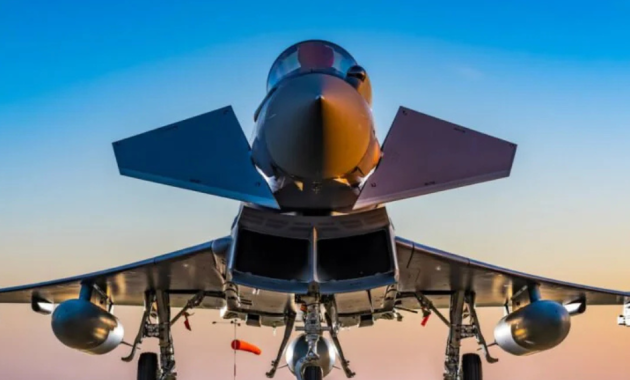
The Eurofighter Typhoon is distinguished by its sleek canard-delta wing configuration, optimized for agility, speed, and multirole flexibility. The canards and fly-by-wire control system provide enhanced maneuverability, making the Typhoon highly effective in dogfighting scenarios. The airframe incorporates radar-absorbent materials and has a reduced radar cross-section, giving it a limited stealth profile.
Its twin Eurojet EJ200 turbofan engines provide a high thrust-to-weight ratio and supercruise capability, allowing the aircraft to sustain supersonic speeds without afterburners. The cockpit features a glass interface with voice command capability, helmet-mounted sight system (HMSS), and wide-angle head-up display (HUD) for increased situational awareness.
Avionics and Systems
The Typhoon is equipped with state-of-the-art avionics, including the CAPTOR-M radar, which is being upgraded to the AESA (Active Electronically Scanned Array) CAPTOR-E radar. The aircraft also integrates the Defensive Aids Sub-System (DASS), providing threat detection, electronic countermeasures, and missile approach warnings.
Its sensor suite includes the PIRATE (Passive Infrared Airborne Track Equipment) for infrared search and track (IRST), giving the Typhoon the ability to detect and track enemy aircraft without emitting radar signals. This passive tracking is particularly useful in stealth and beyond-visual-range (BVR) engagements.
Armament and Mission Capabilities
The Eurofighter Typhoon is a true multirole platform, capable of carrying a vast array of weaponry. It can engage air, ground, and naval targets using precision-guided munitions, air-to-air missiles, and anti-ship missiles.
In air-to-air combat, the Typhoon can deploy AIM-120 AMRAAM, IRIS-T, and the long-range Meteor missile, providing beyond-visual-range engagement capability. For ground attack missions, it supports Paveway laser-guided bombs, Storm Shadow cruise missiles, Brimstone anti-tank missiles, and more.
It also has a 27mm Mauser BK-27 revolver cannon, which is effective for close-range engagements and ground strafing. With 13 hardpoints and a maximum external load of over 7,500 kg, the Typhoon offers exceptional payload flexibility.
| Specification | Details |
|---|---|
| Crew | 1 (single-seat), 2 (training variant) |
| Length | 15.96 m (52.4 ft) |
| Wingspan | 10.95 m (35.9 ft) |
| Height | 5.28 m (17.3 ft) |
| Empty Weight | 11,000 kg (24,250 lb) |
| Max Takeoff Weight | 23,500 kg (51,800 lb) |
| Powerplant | 2 x Eurojet EJ200 turbofans |
| Thrust per Engine | 20,000 lbf (90 kN) |
| Maximum Speed | Mach 2.0 (2,495 km/h, 1,550 mph) |
| Supercruise | Mach 1.5 |
| Combat Range | ~1,389 km (863 mi) |
| Ferry Range | 3,790 km (2,350 mi) |
| Service Ceiling | 55,000 ft (16,764 m) |
| Rate of Climb | 315 m/s (62,000 ft/min) |
| Armament | 27mm Mauser BK-27 cannon, missiles, bombs |
| Hardpoints | 13 (for missiles, bombs, fuel tanks, pods) |
| Radar | CAPTOR-M / CAPTOR-E AESA |
| IRST | PIRATE IRST system |
Read Also: The Panavia Tornado, Born to Strike, Built to Last.
Global Operators
The Eurofighter Typhoon is currently operated by several air forces, including:
- United Kingdom (Royal Air Force)
- Germany (Luftwaffe)
- Italy (Aeronautica Militare)
- Spain (Ejército del Aire)
- Austria (Austrian Air Force)
- Saudi Arabia (Royal Saudi Air Force)
- Qatar (Qatar Emiri Air Force)

The aircraft has proven itself in various operations, including air policing missions in Europe, combat sorties in Libya, and surveillance missions in the Middle East. Its adaptability has made it a favored choice for NATO Quick Reaction Alert (QRA) duties.
Future Upgrades and Evolution
The Eurofighter Typhoon program is far from static. Continuous upgrades are being introduced to enhance its radar, communication systems, and weapon integration. The latest Tranche 4 and future Tranche 5 variants will feature increased computing power, upgraded DASS, and full integration of the CAPTOR-E radar.
The Typhoon is expected to remain a front-line fighter well into the 2040s, bridging the gap to sixth-generation platforms like the Future Combat Air System (FCAS) and the British-led Tempest program. Collaborative efforts among the Eurofighter nations ensure that the platform remains interoperable, relevant, and formidable in any conflict scenario.
Conclusion
The Eurofighter Typhoon stands as a testament to European aerospace cooperation and engineering excellence. Blending speed, agility, and versatility, it remains one of the most capable fighter aircraft in operation. Its role in safeguarding European and allied airspace continues to be critical, and ongoing upgrades ensure the Typhoon remains a dominant force in 21st-century aerial warfare.
As geopolitical tensions rise and technology evolves, the Eurofighter Typhoon will undoubtedly continue to soar at the forefront of modern air combat.