HMS Queen Elizabeth, the lead ship of her class of aircraft carriers, stands as a modern symbol of British naval might and engineering prowess. Commanded by Captain Claire Thompson since 2024, she has the capability to carry up to 60 aircraft, including fixed-wing, rotary-wing, and autonomous platforms.
Named in honor of both the World War I-era super-dreadnought HMS Queen Elizabeth and, indirectly, Queen Elizabeth I, the carrier proudly bears her namesake’s battle honors, Tudor rose-adorned crest, and motto. After beginning sea trials in June 2017, the ship was commissioned later that year on December 7 and officially entered service in 2020. Commodore Jerry Kyd, formerly of Ark Royal and Illustrious, served as her first seagoing commanding officer, assuming command in May 2016.
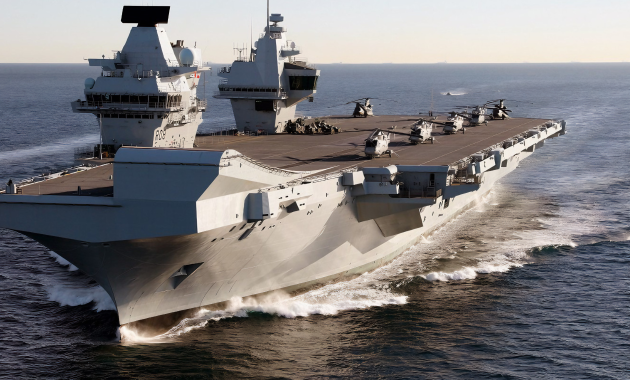
Built with flexibility at its core, Queen Elizabeth is designed to operate V/STOL aircraft such as the F-35B Lightning II, supported by Merlin helicopters tasked with airborne early warning and anti-submarine roles.
The ship can also house 250 Royal Marines and support them with troop-carrying helicopters like the Chinook, making it a formidable force in amphibious operations. Homeported at HMNB Portsmouth, Queen Elizabeth plays a central role in the UK’s global military strategy. She will regularly deploy as the flagship of the UK Carrier Strike Group, a powerful assembly of escort and support ships designed to project British influence and military capability across the world’s oceans.
HMS Queen Elizabeth Specifications:
The Royal Navy’s Queen Elizabeth-class carriers were built using an innovative “block build” method, with massive sections constructed at shipyards across the UK and then assembled at Rosyth Dockyard. Led by the Aircraft Carrier Alliance—a team including BAE Systems, Babcock, Thales, and the Ministry of Defence—the design phase began around 2006–2007, with contracts signed in 2008. Key milestones followed: the first steel was cut in July 2009, she was officially named on 4 July 2014, and floated out just weeks later.
Originally projected to cost £3.9 billion for both carriers, the total bill eventually climbed to around £6.2 billion, largely due to design revisions—most notably abandoning a costly switch to catapult-assisted takeoff (CATOBAR) in favor of a simpler STOVL configuration.
| Category | Details |
|---|---|
| Name | HMS Queen Elizabeth (R08) |
| Class and Type | Queen Elizabeth-class Aircraft Carrier |
| Builder | Aircraft Carrier Alliance (BAE Systems, Babcock, Thales, MoD) |
| Launched | 17 July 2014 |
| Commissioned | 7 December 2017 |
| Entered Service | 2020 |
| Homeport | HMNB Portsmouth |
| Flagship | Yes – Royal Navy flagship |
| Displacement (Full Load) | Approx. 65,000–70,600 tonnes (standard), up to 80,600 tonnes (max) |
| Length | 280 meters (918 ft 7 in) |
| Beam (Waterline) | 39 meters (128 ft) |
| Flight Deck Width | 70 meters (230 ft) |
| Draught | 11 meters (36 ft) |
| Decks | 9 main decks |
| Propulsion Type | Integrated Electric Propulsion (IEP) |
| Gas Turbines | 2 × Rolls-Royce MT30 (36 MW each) |
| Diesel Generators | 4 × Wärtsilä 38 marine diesel generators (9 MW each) |
| Electric Motors | 2 × GE electric motors driving shafts |
| Total Installed Power | ~109 MW |
| Propellers | 2 × Fixed-pitch, 5-blade |
| Speed (Max) | 25+ knots (46+ km/h; classified exact top speed) |
| Range | 10,000 nautical miles at 15 knots |
Also Read: English Electric Lightning: Britain’s Supersonic Interceptor Icon.
Engineering Marvel: Structure and Survivability
The Queen Elizabeth epitomizes modern shipbuilding. Displacing roughly 65,000–80,600 tonnes and stretching about 280–284 m, she’s one of the largest warships ever built for the Royal Navy
Her Integrated Electric Propulsion (IEP) system combines two Rolls‑Royce Trent MT30 gas turbines and four Wärtsilä diesel generators, powering electric motors that turn twin fixed-pitch propellers—a configuration that grants speeds of over 25 knots (about 46 km/h) and an operational range of 10,000 nautical miles.
Automation is central: high-tech visual and thermal cameras monitor some 3,000 compartments, enabling a streamlined crew of around 700, expandable to 1,600 when the full air wing and embarked marines are aboard.
From a damage control perspective, the ship is subdivided into three ‘citadels’—each with independent power, ventilation, and fire mains. Critical systems are duplicated and cross-connected across compartments to enable survival even after sustaining structural damage
Advanced Sensors and Defensive Capabilities
Innovation in warfare systems gives Queen Elizabeth robust situational awareness. Onboard radars include the S1850M long-range, Type 997 Artisan 3D, and in some systems, SAMPSON—capable of detecting aircraft and missiles at ranges well over 400 km. For self-defense, she employs three Phalanx CIWS turrets, four DS30M 30 mm cannons, and six M134 miniguns, geared to fend off anti-ship missiles, fast attack boats, and aircraft.
These systems don’t operate in isolation: the Queen Elizabeth almost always deploys with escorting destroyers, frigates, submarines, and replenishment vessels—forming a layered defense and complete Carrier Strike Group (CSG).
Flight Operations: Deck and Aircraft Handling
A hallmark of Queen Elizabeth is her ski-jump flight deck—about 70 m wide and sometimes described as three football pitches in size—optimized for STOVL aircraft launch. Unlike catapult-assisted CVs, her deck launches aircraft like the F-35B Lightning II, which is supported by two aircraft lifts capable of moving four jets from hangar to flight deck within just 60 seconds.
Typically, her air wing includes 24–36 F‑35Bs, scalable to 48 in extreme circumstances, plus helicopters such as Merlin HM2 for anti-submarine warfare and surveillance. The Queen Elizabeth also supports 820 Naval Air Squadron, known as the “Queen’s Squadron,” which permanently staffs Merlins—incidentally, they performed the first aircraft landing aboard the carrier in April 2017.
Operational History and Global Reach
Since entering service in 2020, Queen Elizabeth has taken center stage in Royal Navy strategic deployments:
In 2021, she led Carrier Strike Group 21, a seven-month, 55,000-nautical mile global deployment through the Mediterranean, Indian Ocean, and into the Indo-Pacific. The mission included joint operations with the U.S., Japan, Australia, and NATO.
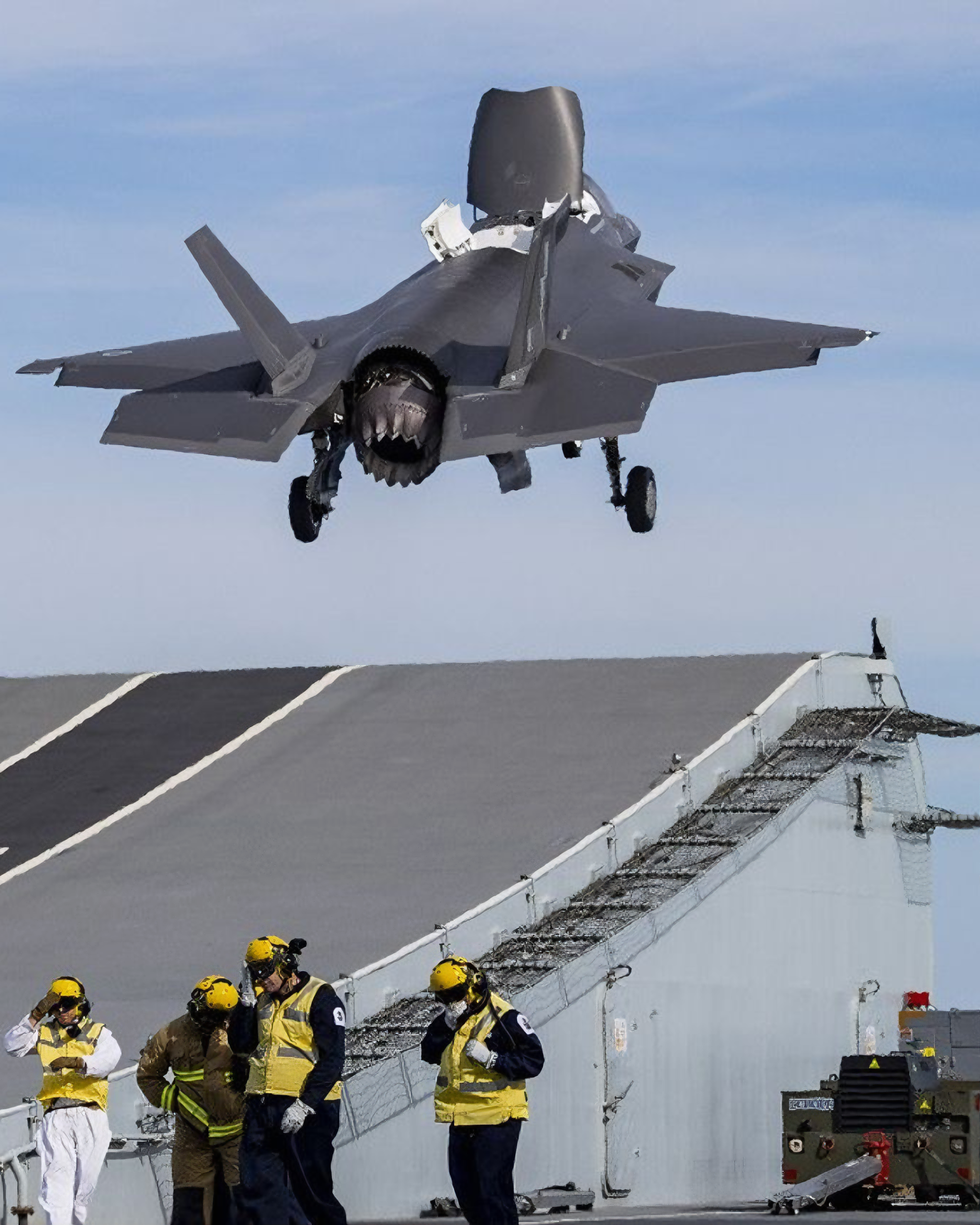
During this deployment, her F‑35Bs achieved significant milestones: British jets conducted the first carrier-based missile firings since 2006, intercepting Mirach target drones during Exercise Strike Warrior.
The carrier also participated in Exercise Neptune Strike under NATO command and was notably shadowed by Russian aircraft and vessels off Cyprus—underscoring her deterrent role.
A technical setback in early 2025 involving a propeller shaft required repairs at Rosyth Dockyard; during this time, the crew was accommodated on a barge named Sans Vitesse nearby.
Onboard Life: Crew Comfort and Facilities
Far from just a flying fortress, Queen Elizabeth offers designer-grade living spaces and amenities. Inside this floating city you’ll find:
-
Comfortable accommodations: 470 cabins for up to 1,600 people.
-
Recreational areas: five gyms, a cinema, and a formal chapel.
-
Dining infrastructure: four large dining areas, served by 67 catering staff, capable of feeding up to 960 personnel in one hour, and an entire company of 700 within 90 minutes (45 at action stations).
-
Medical facilities: A clinic with eight beds, plus operating and dental rooms staffed by 11 medics.
These facilities support operational endurance—Queen Elizabeth carries about 45 days of food supplies, enabling extended deployments without resupply.
Conclusion: A Pillar of 21st-Century Naval Power
HMS Queen Elizabeth stands as a testament to modern naval architecture—blending automation, survivability, and advanced aviation to project UK influence globally. With a modular design primed for future tech, formidable defense systems, and a role in high-profile exercises and deployments, she serves as both a warfighting asset and diplomatic symbol.
As the flagship of the Royal Navy, the Queen Elizabeth underpins Britain’s global mission—to deter threats, safeguard allies, and respond rapidly to crises. While she faces budgetary, operational, and strategic challenges, continued investment and innovation promise to keep her at the forefront of maritime strategy well into the coming decades—ensuring that “Global Britain” sails confidently across the world’s oceans.
