The Saab 29 Tunnan, nicknamed “The Flying Barrel” for its rotund shape, was Sweden’s first swept-wing jet fighter and only the second Swedish turbojet combat aircraft after the Saab 21R. Designed shortly after World War II and powered by a de Havilland Ghost engine, its unique shape and high-speed performance were influenced by German wartime research.
First flown in 1948 and entering service in 1951, the Tunnan exceeded expectations with its agility and speed. Several versions were produced, including the J 29A, B, E, the afterburner-equipped J 29F, and the reconnaissance S 29C. It saw combat in the Congo during UN operations and was also used by Austria, remaining in Swedish service into the 1970s as both a fighter and fighter-bomber.
Saab 29 Tunnan: Origins and Design Development
In the years following World War II, military aviation was evolving at a breakneck pace. Jet propulsion, swept-wing designs, and advanced aerodynamics were reshaping air combat doctrine. Amid this revolution, Sweden—a neutral country but deeply invested in self-reliant defense—produced one of the most unusual and effective early jet fighters of the Cold War era: the Saab 29 Tunnan.
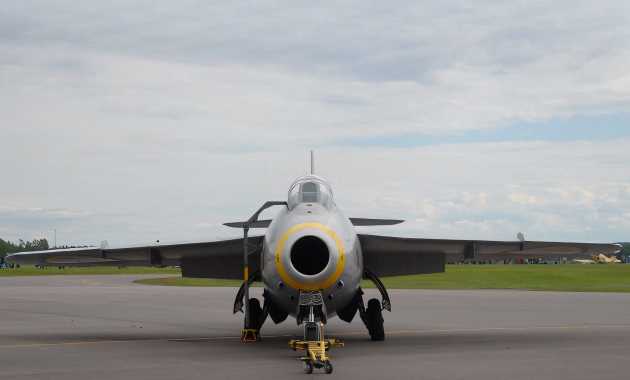
Nicknamed “Flygande Tunnan” or “The Flying Barrel”, the Saab 29 was Sweden’s first production jet aircraft with swept wings, and it emerged as one of the most capable European jet fighters of the 1950s. Its performance, agility, and combat service helped define Swedish air power and showcased the capability of its domestic aerospace industry.
The roots of the Saab 29 trace back to 1945, shortly after the end of World War II. Sweden, having remained neutral during the war but keenly observing global technological developments, sought to rapidly modernize its air force with homegrown jet fighters. Saab’s design team, led by Lars Brising, embarked on the company’s first jet fighter project: Project R 1001, which would later become the Tunnan.
Although initial prototypes used straight wings, Saab engineers quickly pivoted to a swept-wing design after examining German wartime research (notably from the Messerschmitt Me 262 and swept-wing theories from the Luftwaffe’s technical documentation). This decision was pivotal in improving high-speed performance and maneuverability.
The aircraft’s short, stubby fuselage and rounded profile were the result of housing the relatively large and powerful de Havilland Ghost turbojet, a centrifugal-flow engine. This gave the aircraft its iconic barrel-like shape—hence the nickname “Tunnan” (Swedish for “The Barrel”).
Specifications, Maiden Flight and Production
The first prototype, designated J 29, made its maiden flight on 1 September 1948 with English test pilot Bob Moore at the controls. The results were very promising. The aircraft exceeded many of its expected performance parameters, particularly in climb rate and maneuverability.

Full-scale production began soon after, and the first operational unit—the Bråvalla Wing (F 13)—received its aircraft in May 1951. The Saab 29 became the backbone of the Swedish Air Force through much of the 1950s and 60s.
| Saab 29 Tunnan | Specification |
|---|---|
| Role | Fighter / Fighter-Bomber |
| Crew | 1 |
| Manufacturer | Saab AB |
| First Flight | 1 September 1948 |
| Introduced | 1951 |
| Retired (Sweden) | Mid-1970s |
| Number Built | 661 |
| Length | 10.23 m (33 ft 6.75 in) |
| Wingspan | 11 m (36 ft 1 in) |
| Height | 3.75 m (12 ft 4 in) |
| Empty Weight | 4,820 kg (10,625 lb) |
| Max Takeoff Weight | 8,000 kg (17,637 lb) |
| Powerplant | 1 × Svenska Flygmotor RM2B (Ghost) turbojet with afterburner (J 29F) |
| Thrust | 22.2 kN dry / 28 kN with afterburner |
| Maximum Speed | 1,060 km/h (660 mph, Mach 0.91) |
| Range | 900 km (560 mi) |
| Ferry Range | 1,500 km (930 mi) |
| Service Ceiling | 15,000 m (49,000 ft) |
| Rate of Climb | 40 m/s (7,874 ft/min) |
| Armament | 4 × 20 mm Hispano Mk V cannons Up to 1,000 kg (2,200 lb) of bombs/rockets |
| Avionics | Radar-ranging gunsight (later variants) |
Variants and Evolution
Over its service life, the Tunnan evolved through several variants, each improving upon the original:
J 29A
-
The first production version. Equipped with basic avionics and no external fuel tanks.
-
Around 224 built.
J 29B
-
Introduced wingtip fuel tanks, increasing range.
-
Strengthened airframe and improved systems.
-
Most numerous variant, with about 332 built.
S 29C
-
A dedicated reconnaissance version fitted with multiple cameras in the nose.
-
76 units converted from J 29Bs.
J 29E
-
Featured a more advanced radar-ranging gunsight and aerodynamic refinements, including a new canopy design.
J 29F
-
The final and most advanced version.
-
Equipped with an afterburner, significantly boosting thrust.
-
Featured improved control surfaces and wing fences.
-
About 308 converted or built as J 29F, making it a highly capable interceptor.
Operational Service
The Saab 29 served the Swedish Air Force (Flygvapnet) primarily in the fighter and fighter-bomber roles. It was Sweden’s first jet fighter to reach operational status and was deployed extensively in the country’s air defense network during the early Cold War period.
UN Missions in Congo
Perhaps the most notable operational deployment of the Tunnan came not in Sweden, but in Africa, during the Congo Crisis (1960–1964). Under the United Nations banner, Sweden contributed aircraft and personnel to support the ONUC (United Nations Operation in the Congo) peacekeeping mission.
In 1961, a squadron of J 29Bs was dispatched to Léopoldville (now Kinshasa) to provide air support, reconnaissance, and show-of-force missions. The Tunnans flew numerous sorties during this period, marking one of the rare instances where a Swedish-designed combat aircraft saw actual combat operations. The aircraft performed impressively, demonstrating their durability, agility, and reliability in tropical conditions.
Austrian Service
The Tunnan was also exported, albeit in small numbers. Austria purchased 30 J 29Fs in the late 1950s, which served in the Austrian Air Force until 1972. It was the first jet fighter to serve with Austria after the country regained its sovereignty post-World War II.
Performance and Handling
Despite its rotund appearance, the Tunnan proved to be a fast and nimble aircraft. It could climb rapidly, had excellent turning ability, and held its own against many contemporary Western fighters of the early 1950s.
The later J 29F variant, with its afterburning engine, pushed the aircraft’s speed envelope close to 1,060 km/h (Mach 0.91) at altitude, making it among the fastest non-supersonic fighters of its day. It was also rugged and easy to maintain, important traits for a country preparing for possible defensive action on home soil.
Legacy
The Saab 29 Tunnan played a crucial role in establishing Sweden as a serious player in jet-age aviation. Its success paved the way for later designs such as the Saab 32 Lansen, Saab 35 Draken, and ultimately the JAS 39 Gripen.

By the time the Tunnan was retired in the 1970s, over 660 aircraft had been built, making it the most-produced jet aircraft in Swedish history. A handful survive today in museums, and a few are still flyable in historic flight displays. The Tunnan remains a symbol of Swedish engineering ambition—a bold, self-reliant leap into the jet age.