MilitaryAndTech.com– When people think of World War II aviation, legendary aircraft like the P-51 Mustang, B-17 Flying Fortress, and Spitfire usually come to mind. Yet behind every famous fighter and bomber was an enormous logistical effort that kept armies supplied, troops moving, and commanders connected across continents. Few aircraft embodied that mission better than the Douglas C-54 Skymaster.
At first glance, the C-54 lacked the dramatic appearance of a combat aircraft. It carried no bombs, engaged in no dogfights, and rarely made newspaper headlines. But what it did was arguably just as important. The Skymaster became one of the Allied forces’ most valuable transport aircraft, carrying soldiers, equipment, mail, medical supplies, and even world leaders across vast oceans and war zones.
Specifications
The Douglas C-54 Skymaster was a four-engine long-range transport aircraft powered by four Pratt & Whitney R-2000 radial engines, each producing 1,450 horsepower. It had a wingspan of 117 feet 6 inches (35.8 m), a length of 93 feet 10 inches (28.6 m), and a maximum takeoff weight of approximately 73,000 pounds (33,100 kg).
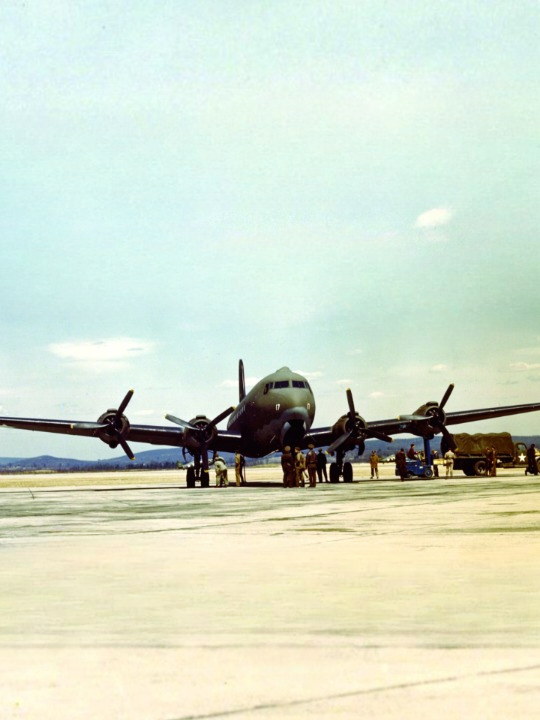
The aircraft could cruise at around 190 mph (305 km/h), reach a top speed of about 275 mph (443 km/h), and fly more than 3,900 miles (6,300 km) on long-range missions. Depending on configuration, the C-54 could carry up to 50 fully equipped troops, 36 stretcher patients, or roughly 28,000 pounds (12,700 kg) of cargo, making it one of the most capable Allied transport aircraft of World War II and the early Cold War.
The aircraft was developed from the Douglas DC-4 airliner, a modern four-engine design intended for commercial service before the war changed everything. As military demand surged, the U.S. Army Air Forces adapted the aircraft into the C-54 Skymaster.
Its spacious cabin, impressive range, and dependable performance made it ideal for long-distance transport missions. Unlike many wartime aircraft that were rushed into service, the C-54 proved remarkably reliable from the beginning.
Operational Service
Throughout World War II, Skymasters operated on routes stretching from North America to Europe, Africa, and the Pacific. They carried thousands of troops and countless tons of cargo to distant fronts where every shipment mattered. The aircraft’s ability to travel thousands of miles without frequent refueling gave Allied commanders a powerful tool for moving personnel and supplies quickly across the globe. In many ways, the C-54 helped shrink the world, connecting battlefronts separated by entire oceans.
The Skymaster also earned a reputation as a VIP transport. Perhaps its most famous passenger was President Franklin D. Roosevelt, who flew aboard a specially modified C-54 known as the “Sacred Cow.” The aircraft featured custom accommodations designed to meet the president’s needs and demonstrated the confidence military leaders placed in the Skymaster’s safety and reliability.
You May Like To Read: Messerschmitt Me 323 “Gigant”: The Giant of the Luftwaffe
Yet the aircraft’s greatest moment came after World War II had ended. In 1948, the Soviet Union blockaded West Berlin, cutting off ground access to the city. Rather than abandon the isolated population, the Western Allies launched what became known as the Berlin Airlift. Day and night, transport aircraft delivered food, fuel, and essential supplies to more than two million people.
At the heart of this historic operation was the C-54 Skymaster. Hundreds of these aircraft flew continuous missions into Berlin, landing every few minutes at the peak of the operation. Pilots faced difficult weather, crowded air corridors, and relentless schedules, but the Skymaster performed magnificently. The success of the Berlin Airlift became one of the defining achievements of the early Cold War and transformed the C-54 into a symbol of humanitarian determination.
Even after its military career began to wind down, the Skymaster continued serving around the world. Many aircraft found second lives with commercial airlines, cargo operators, and civilian organizations. Some remained in service for decades, a testament to the strength of their design and construction.
Legacy
Today, the Douglas C-54 Skymaster is remembered not for spectacular aerial victories but for something equally important: reliability. It proved that wars are won not only by the aircraft that fight, but also by the aircraft that keep entire nations supplied and connected. Quietly, efficiently, and often far from the spotlight, the Skymaster helped shape the outcome of the twentieth century and earned its place among the most important transport aircraft ever built.